Developing story update (June 26, 2026, 16:29 UTC):
Update: the outflows have deepened. The following session saw Bitcoin ETFs shed roughly $696.29 million, a notably larger exit than the $469.08 million we first reported and an extension of the redemption streak.
This time BlackRock was not alone at the front. Fidelity joined IBIT as a lead source of the outflows, a sign the selling pressure is broadening across the major issuers rather than sitting with a single fund.
What to watch now: Whether a sixth straight day of ETF outflows forces a flush into the lower reaccumulation zone or invites a short-term bounce.
Developing story update (June 26, 2026, 08:32 UTC):
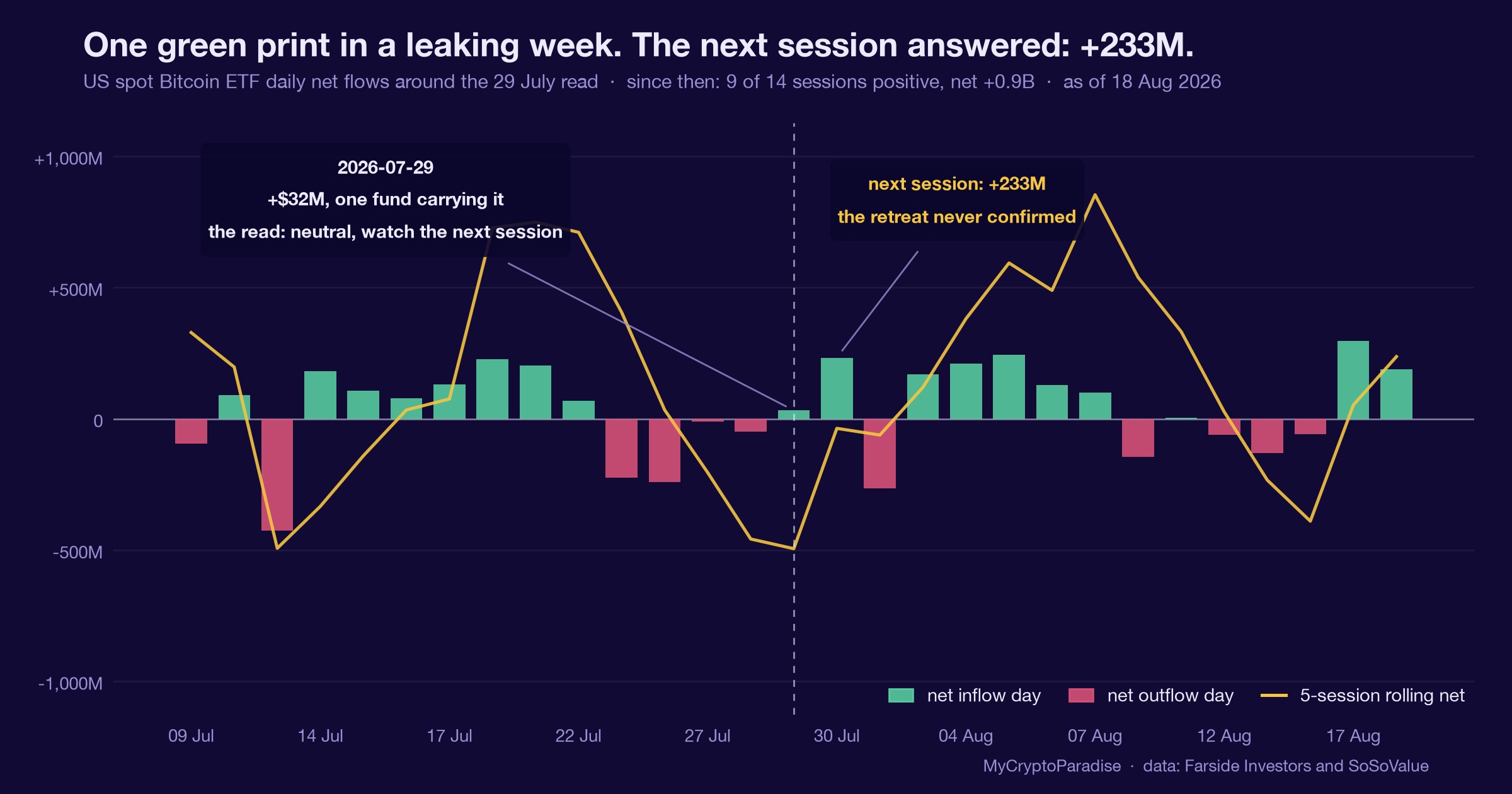
Update: The selling pace is now showing up in the smoothed data, not just single days. The seven-day rolling average of net flows for US spot Bitcoin ETFs has slipped to roughly negative $300 million per day, confirming the outflows are a sustained trend rather than a one-day spike.
For traders this keeps the short-term bias heavy. A steady drain at this pace argues that institutional supply is still hitting the market, which supports the case for a deeper flush toward our $55,000 to $44,000 reaccumulation zone before any durable bottom. This is a probability read, not a certainty.
What to watch now: Watch whether the 7-day average outflow pace deepens past -$300M per day or starts to flatten, the first tell of exhaustion.
Developing story update (June 26, 2026, 06:44 UTC):
Bitcoin ETFs have now recorded $3.4 billion in net outflows over a single week, significantly expanding on the daily figures previously reported.
BlackRock’s IBIT alone lost over $1 billion during this period, with its price crashing to a new yearly low of $33.41.
This broader weekly perspective confirms the sustained pressure on institutional holdings, indicating a deeper deleveraging event.
What to watch now: Traders should monitor the $55,000-$44,000 range for potential reaccumulation as institutional selling continues.
Developing story update (June 26, 2026, 04:11 UTC):
New data reveals Bitcoin ETFs experienced $3.4 billion in net outflows over a single week in June, with BlackRock’s IBIT alone losing over $1 billion during that period.
This broader weekly trend underscores the daily $469 million outflow previously reported, highlighting sustained selling pressure.
Bitcoin’s dip towards $59,000 marked its first time at that level since September 2024, alongside $681 million in retail liquidations, suggesting a significant shakeout of weaker hands.
What to watch now: The market's ability to absorb these sustained outflows and reclaim key support levels.
Developing story update (June 26, 2026, 02:46 UTC):
Update: The flush has now been quantified across the wider market. Total crypto liquidations have climbed to roughly $1.48 billion, confirming that this was a leverage washout and not just passive ETF redemptions.
BlackRock’s IBIT also printed a yearly low near $33.41, a sign that the largest spot vehicle absorbed the brunt of the selling. For traders this often marks the kind of forced-seller exhaustion that can precede a reclaim attempt, though a recovery only confirms if higher levels are taken back.
What to watch now: Watch whether liquidations cool and BTC reclaims $63,000 to confirm sellers are exhausted.
Developing story update (June 26, 2026, 00:15 UTC):
Update: the pressure deepened on June 24. Bitcoin slid toward $59,000, its first visit to that level since September 2024, as the broader market saw roughly $1.48 billion in liquidations over 24 hours.
The forced selling extended to the funds themselves: IBIT touched a yearly low of $33.41 on the day. For traders, this looks less like fresh conviction selling and more like over-leveraged positions being cleared out, the kind of flush that can reset the field before any attempt to stabilize.
What to watch now: Whether liquidation volume cools and Bitcoin holds the $59,000 area, or rolls into a sixth straight outflow day.
Developing story update (June 25, 2026, 23:31 UTC):
An update to our analysis of Bitcoin ETF outflows confirms BlackRock’s IBIT held $47.42 billion in net assets as of Tuesday.
This figure provides additional context to the recent $239.29 million outflow from IBIT, indicating the scale of the redemptions relative to its total holdings.
Our read remains consistent, viewing these outflows as institutional profit-taking and a reaccumulation phase by smart money.
What to watch now: Monitor IBIT's net asset changes for further indications of institutional sentiment and accumulation trends.
Developing story update (June 25, 2026, 22:48 UTC):
Further details on Bitcoin ETF movements for June 23 reveal that while overall net outflows persisted, some funds experienced inflows.
Fidelity’s FBTC attracted approximately $23 million, and ARK 21Shares’ ARKB saw inflows of around $31 million on that day.
This indicates a more complex picture of capital rotation within the ETF market, even as the broader trend of withdrawals continues.
What to watch now: Monitor individual ETF flow data for signs of shifting institutional sentiment.
Developing story update (June 25, 2026, 21:21 UTC):
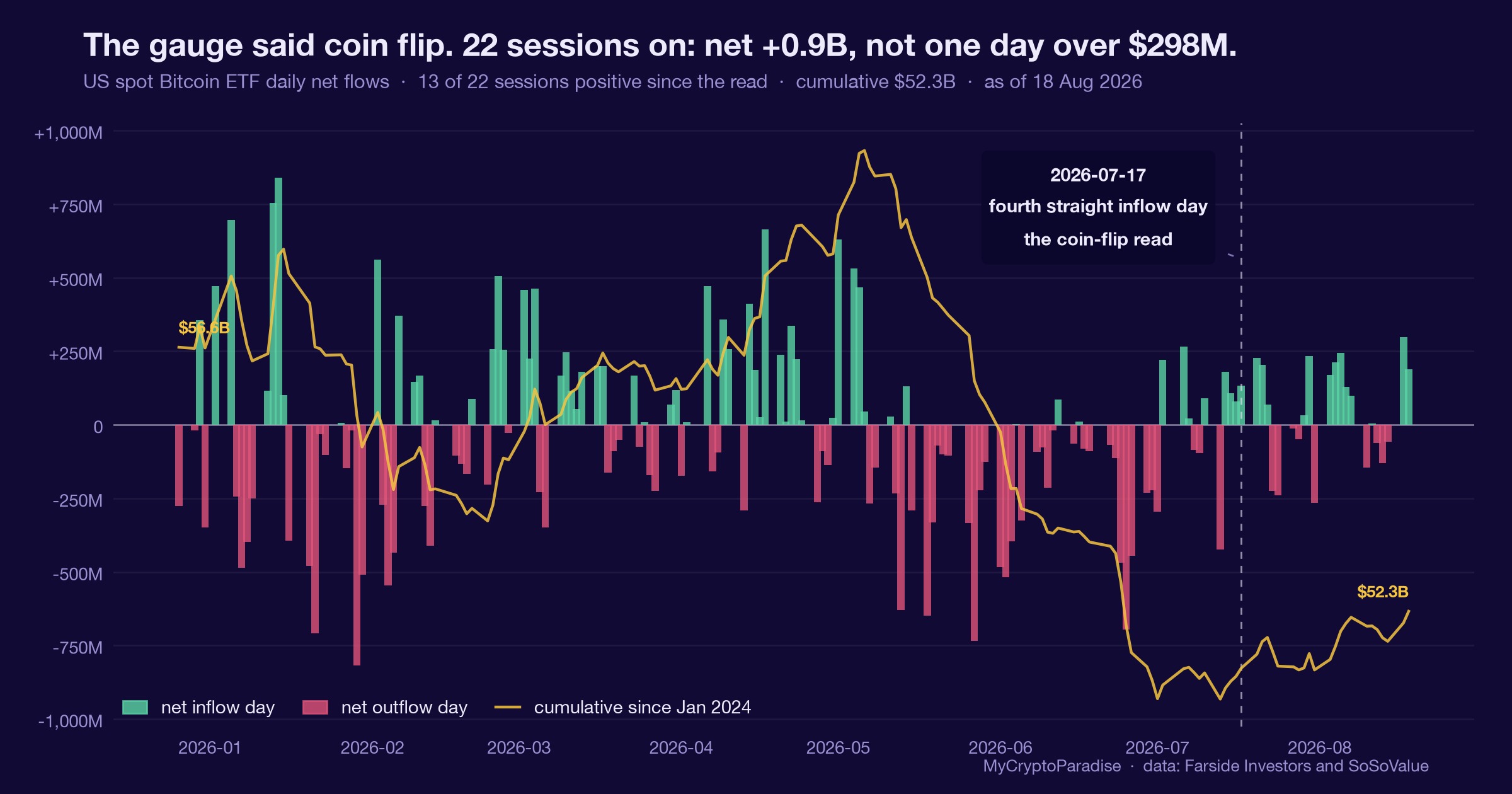
Update: the outflow picture is broader than a single session. Over the past 30 days, US spot Bitcoin ETFs have shed more than $6 billion on a net basis, with BlackRock’s IBIT accounting for roughly $2.7 billion of that over a five-week window.
For traders, the takeaway is scale. This is not a one-day wobble but a sustained, multi-week unwind of institutional exposure. We continue to read it as a shakeout of weaker positioning rather than a structural top, with smart money more likely to treat these levels as a reaccumulation zone than to chase the exit.
What to watch now: Watch whether the multi-week outflow streak finally breaks with a single net inflow day, the first sign professionals are stepping back in.
Listen: the 2-minute breakdown
By the ParadiseTeam · Updated June 2026
Market briefing: Bitcoin ETFs bled $469 million on June 24, a fifth straight day of withdrawals led by BlackRock's IBIT. We read this as retail capitulation feeding a smart money reaccumulation phase, not the start of a deeper collapse.
- US spot Bitcoin ETFs posted $469 million in net outflows, the fifth straight down day, with BlackRock's IBIT alone shedding $239.3 million.
- Bitcoin slipped below $60,000 and then below $59,000 as forced selling and rising yields pressured a market now trading like a risk asset.
- The ParadiseTeam still reads this as reaccumulation: clearing leverage and panic before any push back toward $63,000 and higher.
Bitcoin ETF outflows just hit $469 million in a single day, the heaviest exit in weeks. Is this smart money leaving, or smart money setting a trap for panicked retail?
Money left the Bitcoin ETF complex fast on Wednesday, June 24. US spot Bitcoin ETFs recorded $469 million in net outflows. That was the fifth consecutive day of withdrawals, and the largest single-day exit in weeks. The selling was concentrated at the top. BlackRock's IBIT shed $239.3 million. Fidelity's FBTC lost $120.8 million. ARK 21Shares' ARKB gave back $50.7 million, and Bitwise's BITB saw $27.5 million walk out the door. Across separate sessions the bleeding continued, with one day showing $113.8 million in net outflows and IBIT contributing $182 million of it. Price followed the flows. Bitcoin slipped below $60,000, then below $59,000. At the time of writing it trades near $59,241, down about 1 percent on the day. XRP sits near $1.031, off 2.2 percent. On the surface this looks like institutions heading for the exits. We see something different underneath. Big outflows clustered in the largest funds usually mean profit-taking and portfolio rebalancing, not a structural change of heart. The structure that matters here is who gets shaken out, and who quietly buys what they leave behind. That is the real story behind the Bitcoin ETF outflows, and it ties directly to where price goes next.
Why Bitcoin ETF outflows Matters for Crypto
The driver is simple. Heavy Bitcoin ETF outflows pull spot demand out of the market at the exact moment macro conditions turn unfriendly. Hawkish central bank signals and rising Treasury yields make every risk asset more expensive to hold. Bitcoin now sits inside institutional portfolios. So it trades like a risk asset. When yields rise, allocators trim the most volatile sleeve first, and ETF redemptions are how that trim shows up. This is the transmission mechanism. Outflows reduce passive bid. Thinner bid lets price slide into zones where leveraged longs keep their stop losses. Those stops trigger liquidations. Liquidations force more selling, which deepens the move and pulls price below round numbers like $60,000 and $59,000. Each level that breaks invites the next wave of forced sellers. That is why a number that looks like dry accounting, $469 million, matters to every trader holding spot or leverage. It is honest to say there was no single confirmed same-day catalyst. We are not pointing to one headline. We are explaining the chain: outflows plus macro pressure equals reduced demand and cascading liquidations. The mechanism is real even when the trigger is diffuse. Understanding it tells you this is a liquidity event, not a verdict on Bitcoin's value.
Market Impact of Bitcoin ETF outflows
Watch the cascade in order. Bitcoin moves first because the ETF flows are Bitcoin flows. Reduced spot bid let price break $60,000, then $59,000, with leverage doing the rest as stops cleared out. Ether felt the second wave. Ether ETFs also stayed negative, so the same redemption pressure that hit Bitcoin dragged ETH lower without a buyer to catch it. Alts came last and fell hardest in percentage terms, the usual pattern when liquidity drains from the top of the market down. One detail stands out. XRP was the only category to draw fresh capital while everything else bled. That tells you the selling was not blind panic across the board. It was targeted rotation and profit-taking, concentrated in the largest Bitcoin vehicles. Here is our edge. Bearish flows hitting a market near support, on a daily timeframe, after retail has already taken heavy liquidations, rarely mark the end. They mark a shakeout. The stops sat below $60,000. They got hit. The retail longs that overpaid for leverage got flushed, with liquidations across the market running into the hundreds of millions. That is who lost. The question is who is buying what they were forced to sell. We think the answer is the same desks that just rebalanced out of the highs.
What to Watch Next After ETF outflow streak
Now we separate confirmation from invalidation, because price will tell you which read is right. On the upside, the ParadiseTeam wants to see a daily candle close back above $63,000. That close would confirm the shakeout thesis and reopen the path toward $70,000. We also want the daily RSI to reclaim its broken trendline and push above its two previous highs. On lower timeframes, the tells are building. The 4-hour MACD is trying to form a bullish divergence, with price making a lower low while the histogram makes a higher low. We want to see three or more higher closing histogram bars and a clean 4-hour MACD bullish cross to trust it. The daily MACD already shows a bullish cross, even without a divergence yet. That is constructive, not conclusive. On the downside, the line that matters is $60,800. We treat it as key support and the invalidation for the bullish case. A decisive daily close and acceptance below it changes the picture from reaccumulation to genuine distribution, and we would step back. Note the honest tension: price has already probed below that zone intraday near $59,000. That is why a daily close, not a wick, is the signal we trust. The daily Stochastic RSI is attempting a bearish cross, a short-term caution flag we are respecting while we wait.
Insights for Traders on Bitcoin ETF outflows
Here is how the ParadiseTeam is positioned. Our bias stays bullish on the daily, medium-term timeframe. We read the $469 million in Bitcoin ETF outflows and the break below $59,000 as retail capitulation inside a smart money reaccumulation phase, not the start of a trend down. Professionals are working the long side here because the risk and reward favors it from these levels. Retail did the opposite and paid for it, with market-wide liquidations running near $681 million, a classic sign of poor risk management right inside the zone where patient capital wants to buy. The map is clear. Immediate resistance and our first confirmation sits at $63,000. A daily close above it opens $70,000 as an intermediate target, with $79,000 as the larger objective if momentum holds. Key support and our invalidation is $60,800. Lose it on a daily closing basis and we stand aside and reassess. We are not promising that path. Probabilities, not certainty. The setup favors continuation, but only confirmation makes it actionable. Until $63,000 closes back overhead, this is a consolidation to manage, not a breakout to chase. We size small, respect $60,800, and let the daily close decide. That is the disciplined way to trade a shakeout instead of becoming part of it.
For exact entries, targets, and stop losses with full risk management, that is what the ParadiseFamilyVIP is for. New to reading these moves? Start with our crypto trading strategies guide.
ParadiseTeam is monitoring the market situation closely, and we are taking these developments into consideration while building our trading tactics inside ParadiseFamilyVIP.
Crypto trading involves substantial risk. Prices are volatile and you can lose money. This article is educational and is not financial advice. Past performance does not guarantee future results.