Developing story update (June 27, 2026, 02:56 UTC):
Update: The crossover proved short-lived. Ethereum has since reclaimed the second spot by market capitalization, with Tether slipping back to third.
ETH has recovered to around $1,583, up roughly 3.9 percent over 24 hours after marking its lowest price of the year on Friday. The flip looks to have been a transient reaction to that dip rather than a lasting change in the asset order.
What to watch now: Whether ETH holds above its yearly low or revisits it, which would put the USDT crossover back in play.
Developing story update (June 26, 2026, 18:19 UTC):
Update: This was the first time USDT has overtaken Ethereum by market cap in roughly seven years, underscoring how unusual the moment is rather than how durable it might be.
Stablecoins now account for close to 15% of the total crypto market cap. That is a clear read on positioning: a large share of capital is parked in liquid, non-volatile form, which tends to signal a defensive posture rather than fresh risk appetite.
What to watch now: Watch whether the stablecoin share keeps climbing toward 15% plus, a sign capital is still sitting out rather than re-entering.
Developing story update (June 26, 2026, 09:59 UTC):
Update: the flip looks to have been a brief crossover rather than a permanent reordering. At the peak of the cross USDT sat near 186.06 billion against Ethereum near 185.66 billion, a razor-thin gap that can swing back and forth on small moves.
Ethereum has continued to slide since, with the 24-hour drop widening to roughly 5.7 percent and price probing the 1,510 to 1,552 area. The deeper read is unchanged: capital is still rotating toward stable assets, and a tight stablecoin-versus-ETH ranking tends to mark risk-off conditions rather than a structural shift.
What to watch now: Watch whether ETH holds the 1,500 area or loses it, which would keep this crossover live instead of one-off.
Listen: the 2-minute breakdown
By the ParadiseTeam · Updated June 2026
Market briefing: Tether USDT is now the second-largest cryptocurrency by market cap, surpassing Ethereum. This shift signals a pronounced flight to safety, reinforcing a bearish outlook for risk assets.
- Tether's USDT circulating supply reached $186 billion, making it the second-largest crypto by market cap.
- Ethereum's market cap was $186.263 billion, with ETH price at $1545.22 after a -6.11% 24-hour decline.
- This shift underscores a broader market downturn and a strong move towards stablecoin liquidity.
Tether's ascent to the second-largest crypto by market cap is a stark signal. With $186 billion in circulation, USDT now exceeds Ethereum. What does this dramatic shift mean for your trading strategy?
A significant structural shift just occurred in the crypto market. Tether's USDT circulating supply reached approximately $186 billion, officially surpassing Ethereum's market capitalization, which stood at $186.263 billion. This move firmly establishes USDT as the second-largest cryptocurrency by market cap. At the same time, Ethereum's price reflects strong selling pressure, trading at $1545.22 after a -6.11% decline over the last 24 hours and a -0.46% drop in just the last hour. USDT, consistently pegged to the US dollar at $0.9985, embodies stability in contrast to ETH's volatility. This event is not merely a ranking change; it signifies a deepening flight to safety. Smart money is actively positioning for capital preservation, moving out of risk assets and into stable, liquid alternatives. The market is clearly signaling a preference for stability amidst a cautious, risk-off environment, setting the stage for what we anticipate will be further institutional capitulation.
Why Flight to Safety Matters for Crypto
The structural implications of Tether's market cap surpassing Ethereum are profound. This isn't just a numerical milestone; it's a macro transmission mechanism at play. The market is firmly in a risk-off environment, with expectations of a broader downturn intensifying. This backdrop fuels increased demand for stablecoin liquidity, as traders prioritize capital preservation over exposure to volatile risk assets. Smart money is strategically accumulating stablecoins, preparing to absorb supply in Bitcoin's key reaccumulation zone between $55,000 and $44,000. This move signals a bearish outlook for risk assets like Ethereum. It highlights how capital flows are dictated by market sentiment, with stablecoins becoming the preferred haven. Retail participation is currently at a six-year low, leaving the market dynamics largely to the actions of institutional players and seasoned traders who are increasingly moving to the sidelines via stablecoin holdings.
Market Impact of Flight to Safety
This flight to safety creates a direct cascade effect across crypto assets. Increased demand for Tether's USDT means capital is actively being pulled from risk assets. For Bitcoin, this dynamic reinforces the cautious outlook. Smart money is not chasing rallies but patiently waiting for institutional capitulation, anticipating a final flush to the $55,000-$44,000 reaccumulation zone. This environment provides the perfect setup for absorbing supply at lower prices. Ethereum, directly impacted by USDT's ascent, sees its market cap decline and price struggle at $1545.22, reflecting its status as a significant risk asset. The -6.11% 24-hour change illustrates this vulnerability. For altcoins, the impact is even more severe. As liquidity drains into stablecoins, altcoins typically experience amplified downside pressure due to their higher beta and lower market depth compared to BTC and ETH. The overall market liquidity becomes concentrated in stablecoins, setting the stage for potential swing short opportunities in risk assets.
What to Watch Next After Tether Market Cap Overtakes ETH
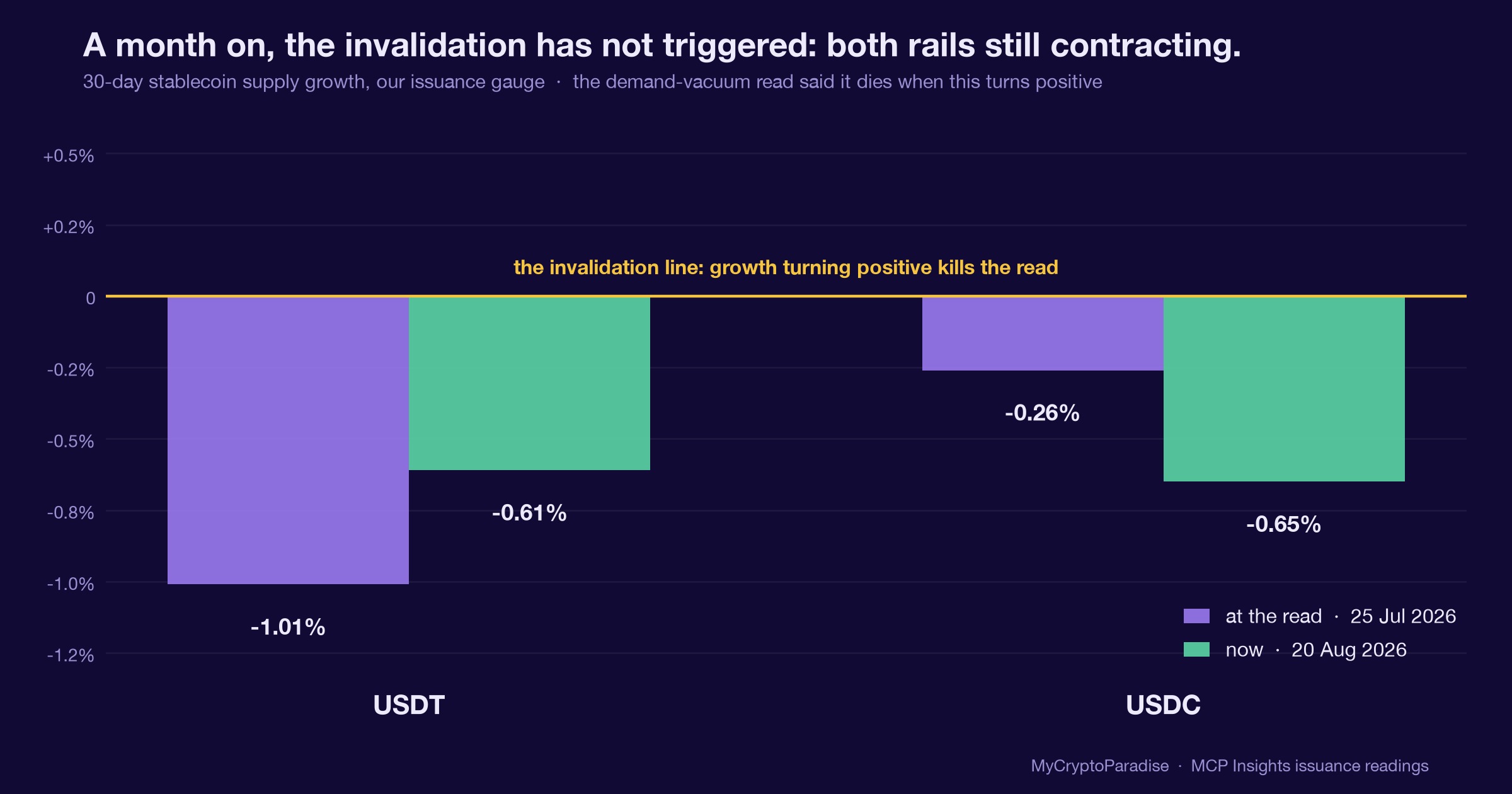
To confirm the ongoing flight to safety and the deepening bearish outlook, traders should monitor several key indicators. Watch for a sustained period where our market index goes 'red below zero', indicating prolonged institutional frustration and capitulation. This should ideally be accompanied by at least three lower lows. Concurrently, we look for higher highs on spot accumulation volume, particularly within Bitcoin's $55,000-$44,000 zone. This confluence would strongly signal the formation of a macro bottom. A potential short-term bounce towards BTC's $73,000-$79,000 levels should be viewed as a swing short opportunity, not an invalidation of the broader bearish thesis. Invalidation would require a significant, sustained reversal of stablecoin dominance, alongside a forceful break and hold above critical resistance levels for both BTC and ETH, fundamentally contradicting the prevailing risk-off sentiment.
Insights for Traders on Flight to Safety
The ParadiseTeam maintains a cautious bias, anticipating a short-term bounce for swing short entries before the final flush to the macro bottom zone. The ParadiseTeam identifies Bitcoin's key reaccumulation zone between $55,000 and $44,000. This is where smart money is prepared to absorb institutional capitulation. We are looking for potential short-term resistance and swing short entry targets for BTC at $73,000, aligning with a significant moving average, and $79,000, which corresponds to a CME gap and the 786 Fib level. The current local low for BTC is $59,000. We expect institutions, having been less diligent in their strategies, to be forced into selling at a loss. This will drive the final move down. Keep an eye on the completion of the fifth wave of an ending diagonal pattern to the downside. Retail participation is at a six-year low, underscoring that current market moves are primarily driven by sophisticated players.
For exact entries, targets, and stop losses with full risk management, that is what the ParadiseFamilyVIP is for. New to reading these moves? Start with our crypto trading strategies guide.
ParadiseTeam is monitoring the market situation closely, and we are taking these developments into consideration while building our trading tactics inside ParadiseFamilyVIP.
Crypto trading involves substantial risk. Prices are volatile and you can lose money. This article is educational and is not financial advice. Past performance does not guarantee future results.