Listen: the 2-minute breakdown
By the ParadiseTeam · Updated June 2026
Market briefing: South Korea's KOSPI fell 5% and the exchange tripped a selling sidecar, spilling risk-off pressure into crypto. Bitcoin slid to $58,775 and Ethereum to $1,528, yet the ParadiseTeam reads this drop as retail panic feeding a smart money reaccumulation phase.
- KOSPI plunged 5% and the Korea Exchange activated a selling sidecar to suspend program selling.
- Risk-off pressure pushed BTC to $58,775 (-3.1% 24h) and ETH to $1,528 (-5.5% 24h).
- The ParadiseTeam reads the fear as retail capitulation inside a reaccumulation zone, not a trend break.
The KOSPI plunge just yanked liquidity out of risk assets, and crypto felt it fast. But when retail panics into a sidecar halt, who quietly buys the fear?
South Korea's stock market broke first. The KOSPI plunged 5% in a single session. The drop was violent enough that the Korea Exchange activated a selling sidecar, a circuit that suspends program selling when the slide turns disorderly. That mechanism only triggers when machines start dumping faster than humans can think. This is not noise. The KOSPI has now closed with moves of 5% or more on 20 trading days this year. Across all of last year, that happened twice. Volatility has become the regime, not the exception. South Korea sits at the center of global tech and semiconductors, so a shock there rarely stays local. When one of the world's key risk markets cracks, the tremor travels through every asset that trades on appetite for risk. Crypto sits at the far end of that chain. Bitcoin slid to $58,775, down 3.1% over 24 hours. Ethereum fell harder, down 5.5% to $1,528. On the surface it looks like contagion doing its work. Look closer and the picture splits. Both coins printed a small green hour even as the daily damage held, BTC up 0.08% and ETH up 0.13% on the hour. That is the early signature of selling exhaustion, not acceleration. The KOSPI plunge gave retail a reason to flee. It also handed patient capital a discount.
Why KOSPI plunge Matters for Crypto
The KOSPI plunge matters because of how risk-off pressure transmits, not because Korean equities and crypto share a chart. The chain is simple. A 5% index drop plus a sidecar halt signals disorderly selling in a core tech market. That forces a broad reassessment of risk appetite across regions. Funds reduce exposure, raise cash, and tighten the liquidity available for speculative assets. Crypto is the most speculative seat in the room, so it gets repriced first and fastest. That is why ETH fell 5.5% while BTC fell 3.1%. Higher-beta assets always take the larger hit when liquidity contracts. None of this is a crypto-specific problem. There was no exchange failure, no protocol break, no on-chain shock. The selling came from outside, dragged in by an equity tremor. That distinction is the whole point. External shocks tend to overshoot in crypto because retail traders read a falling chart as a falling fundamental. They are not the same thing. When the cause lives in another market, the crypto reaction is often emotional rather than structural. Emotional selling creates dislocations. Dislocations are where mispricing lives. The KOSPI plunge is real and the risk-off it spread is real. But a borrowed shock fades faster than a homegrown one. That is what makes the next few sessions a test of who panicked and who positioned.
Market Impact of KOSPI plunge
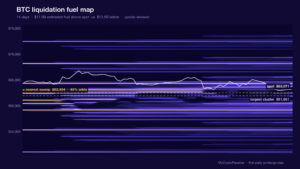
Watch how the liquidity cascade moved through the stack. The KOSPI plunge tightened risk appetite first. Bitcoin absorbed the initial blow as the market's risk anchor, falling 3.1% to $58,775. Ethereum, with higher beta, took the heavier hit at -5.5%, sliding to $1,528. Alts sit further out the risk curve, so they bleed more on every move down and lag on every bounce back. This is the standard order of a risk-off flush: BTC leads, ETH amplifies, alts exaggerate. The retail side already paid for it. Roughly $681M in long liquidations were flushed out, the fingerprint of crowded positions and thin risk management meeting a sudden external shock. Forced selling is not informed selling. It is leverage getting cleared, and it tends to print the panic low rather than mark a new trend. The tell sits in the hourly tape. After the daily damage, both BTC and ETH ticked higher on the hour. That fractional green is small, but it shows sellers losing momentum at lower prices. When an external shock cannot keep crypto falling intraday, the move is closer to capitulation than continuation. The KOSPI plunge supplied the fear and the fuel for liquidation. Now the question is whether crypto keeps following Korean equities lower or starts to decouple as forced sellers run out of supply.
What to Watch Next After KOSPI sidecar halt
Confirmation and invalidation now hinge on a handful of levels, and the KOSPI plunge backdrop makes the next few daily closes the real signal. The market just cleared leverage, so the question is which side gets hit on the rebuild. The ParadiseTeam is watching for Bitcoin to first reclaim its key support zone, then prove it with a daily candle close above $63,000. That close is the confirmation trigger. Below it, the bounce stays unconfirmed and the risk-off tape from Korea can still drag price. Structure offers early clues before the close. The 4-hour MACD is attempting a bullish divergence, a lower price low against a higher histogram low, which often precedes a turn. We want to see three or more higher closing bars on that histogram and a bullish cross to back it. On the daily, the MACD already printed a bullish cross with the histogram building, though no bullish divergence yet. The caution flag is the daily Stochastic RSI attempting a bearish cross, a reminder that momentum is not one-directional here. Invalidation is just as clear. A decisive loss of the lower support band and a failure to reclaim it would say the KOSPI-driven risk-off is winning and the reaccumulation read is wrong. Confirmation builds upward from $63,000. Invalidation builds downward from the loss of support. Let the close decide, not the panic.
Insights for Traders on KOSPI plunge
Here is the ParadiseTeam’s read. The ParadiseTeam stays bullish on Bitcoin, medium-term on the daily, treating this KOSPI-driven flush as retail capitulation inside a smart money reaccumulation phase. The $681M in long liquidations is the evidence: forced sellers cleared out near the lower edge of the zone where professionals prefer to accumulate. Favorable risk versus reward sits on the long side from here. The map is layered. Immediate resistance and the first real confirmation is a daily close above $63,000. Clear that with momentum and the path opens toward $70,000 as the intermediate target, then $79,000 as the primary objective for this leg. The line that matters most is $60,800. That is our key support and the invalidation. Hold and reclaim it, and the reaccumulation thesis stays intact. Lose it decisively and fail to recover, and we step back and let the structure reset rather than fight it. Process over prediction. We want the RSI to reclaim its trendline and break two prior highs, the 4-hour MACD to print three-plus higher histogram bars into a bullish cross, and the daily to confirm the existing cross. This is a probability read, not a forecast. External shocks like the KOSPI plunge create the discount. Discipline at these levels, not hope, is what turns a panic into an entry.
For exact entries, targets, and stop losses with full risk management, that is what the ParadiseFamilyVIP is for. New to reading these moves? Start with our crypto trading strategies guide.
ParadiseTeam is monitoring the market situation closely, and we are taking these developments into consideration while building our trading tactics inside ParadiseFamilyVIP.
Crypto trading involves substantial risk. Prices are volatile and you can lose money. This article is educational and is not financial advice. Past performance does not guarantee future results.