Developing story update (June 27, 2026, 09:48 UTC):
Update: since this story published, Bitcoin briefly flushed to $58,000 before recovering toward $60,300, and the move triggered roughly $1.26 billion in crypto liquidations across the market. The forced selling lines up with the capitulation pressure we flagged.
Price is back near where it started, so the wick has so far been absorbed. We still see the $55,000 to $44,000 reaccumulation zone as the area where smart money is more likely to step in, and we are not there yet.
What to watch now: Whether a fresh push lower re-tests $58,000 or extends toward the $55,000 to $44,000 zone on continued liquidations.
Developing story update (June 27, 2026, 06:11 UTC):
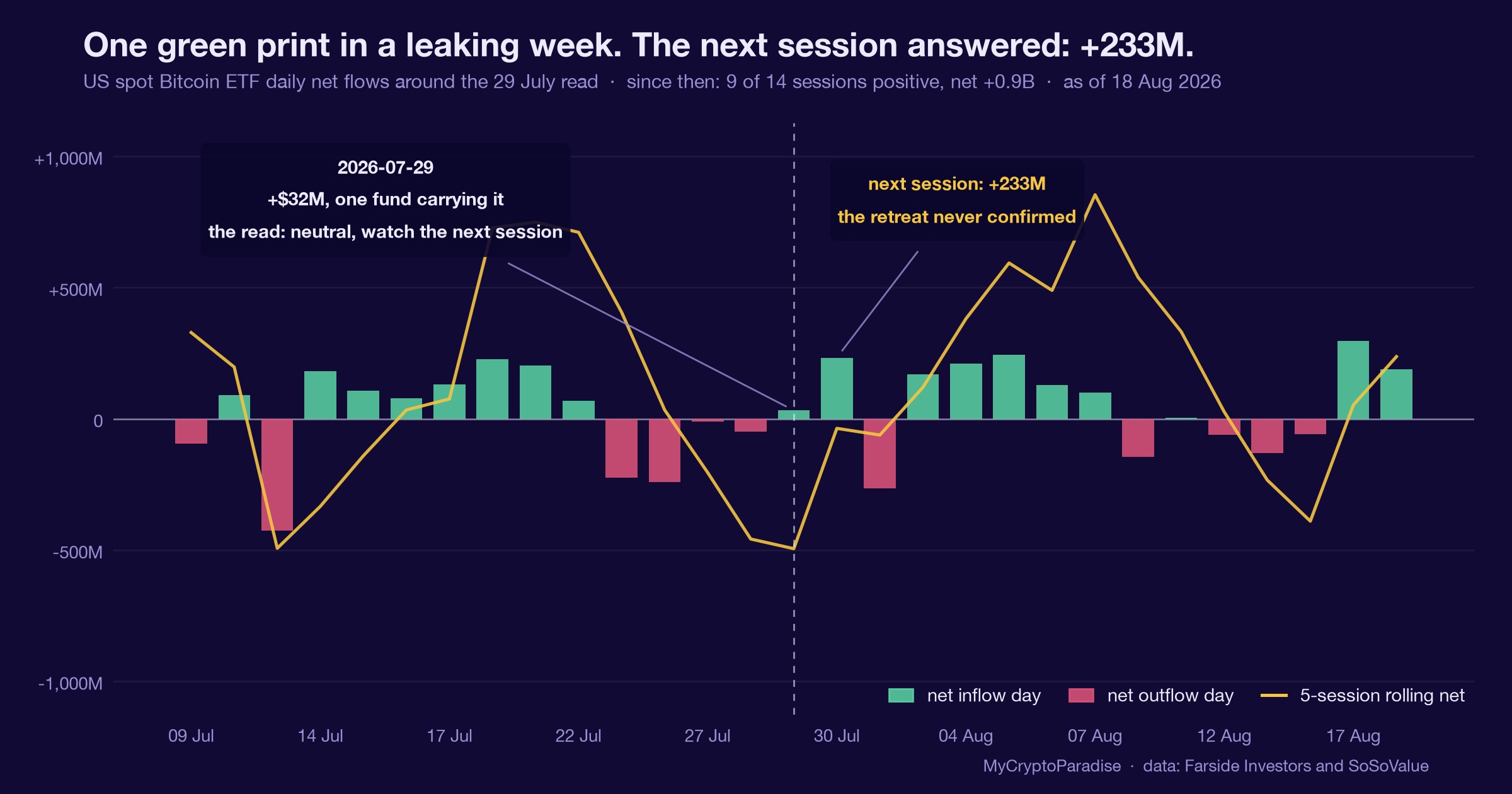
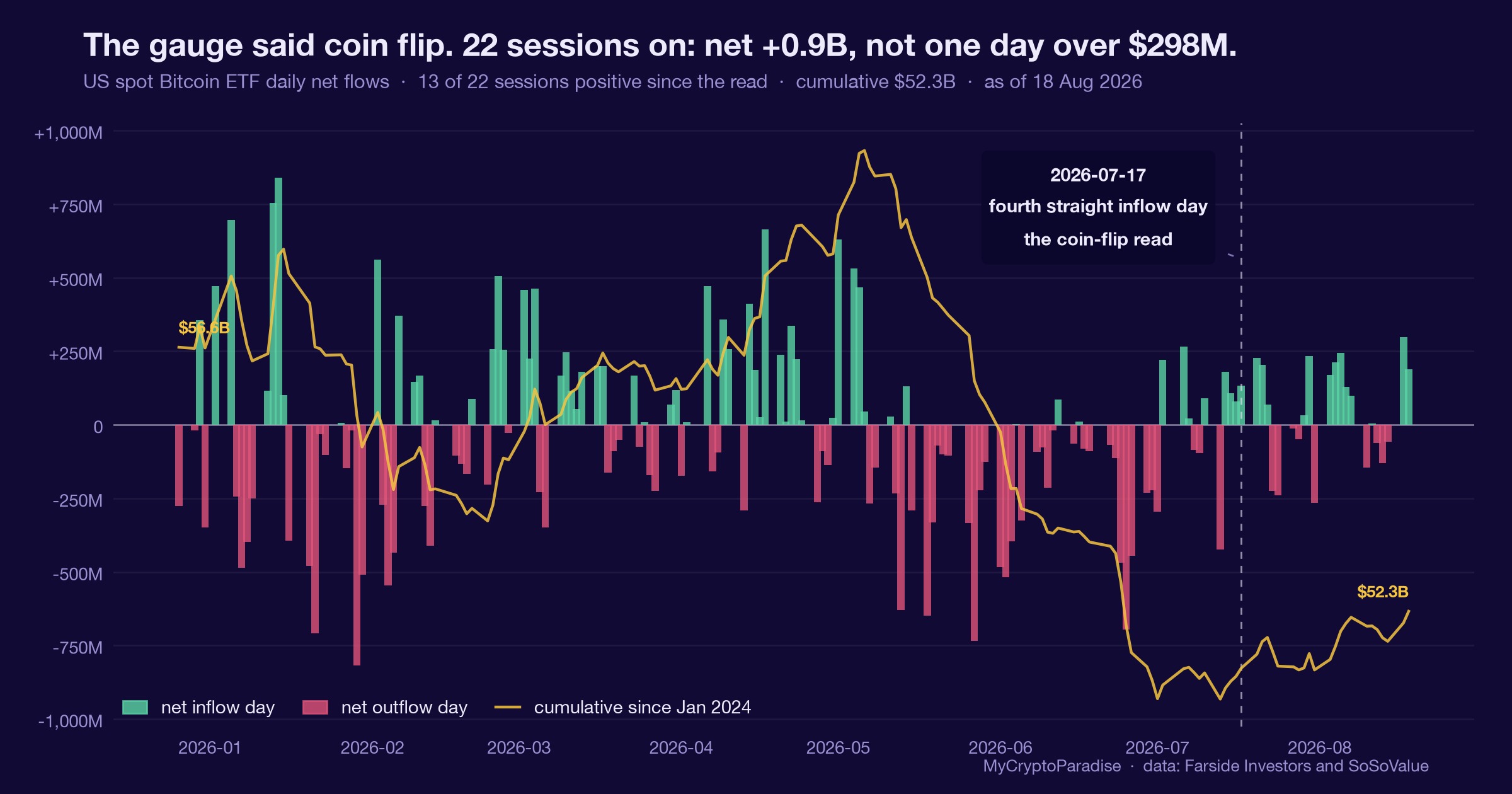
The outflow picture has sharpened. Spot Bitcoin ETFs have now logged two consecutive days of near $1 billion in combined outflows, among the heaviest single-day prints recorded this year. That points to institutional positions being trimmed rather than added.
The macro backdrop hardened too. The Federal Reserve’s preferred inflation gauge, the PCE measure, climbed to its highest reading since 2023. A hotter print lowers the odds of near-term rate cuts and keeps pressure on risk assets, Bitcoin included.
For traders, this reinforces the existing setup: relief bounces remain probable, but the weight of flows and policy still leans lower toward the macro reaccumulation zone.
What to watch now: Whether ETF outflows extend a third day or reverse as the next macro data prints.
Developing story update (June 27, 2026, 00:03 UTC):
Update: the slide has deepened since publication. Bitcoin printed a fresh low near $58,000 before steadying back around the $60,000 mark, and the macro driver is now clearer: US May PCE inflation came in hotter than expected, which strengthens the case for the Fed to stay restrictive for longer.
The institutional exit also sharpened. Spot Bitcoin ETFs logged a single-day net outflow of close to $700 million, and total crypto liquidations across the move reached roughly $1.26 billion. That combination keeps the $60,000 floor fragile and raises the probability of another flush toward our $55,000 to $44,000 reaccumulation zone.
What to watch now: Whether the $58,000 low holds or breaks on the next ETF outflow print and post-PCE Fed commentary.
Developing story update (June 26, 2026, 19:23 UTC):
Update: the fragile floor we flagged has now given way. Bitcoin has traded below $60,000 for the first time since October 2024, slipping to roughly $59,873 as the level that had been holding finally broke.
The move came with a sharp deleveraging event: close to 180,000 traders were liquidated in a single 24 hour window, a sign that crowded leveraged positions were forced out. ETF outflows remain heavy and the $10.6 billion quarterly expiry on June 26 still sits ahead of the market.
What to watch now: Whether the break below $60,000 holds and presses toward the $55,000 to $44,000 reaccumulation zone, or snaps back as a failed breakdown into the June 26 expiry.
Listen: the 2-minute breakdown
Developing story update (June 26, 2026, 16:08 UTC):
A fresh catalyst is now on the calendar: a roughly $10.6 billion quarterly Bitcoin options expiry is set for June 26. Large expiries of this size can compress and then release volatility as positions roll or settle, so traders should expect sharper intraday swings into and just after the event.
The institutional picture has not improved. Spot Bitcoin ETF outflows remain the dominant pressure, and price is still pinned to the same fragile $60,000 zone we flagged. Any short-lived push higher around the expiry can probably be treated as positioning noise rather than a confirmed trend change until that floor holds with conviction.
What to watch now: Whether the June 26 options expiry triggers a volatility spike that decisively defends or breaks the $60,000 floor.
Bearish for crypto
Market briefing: Bitcoin trades at $58,988, down 3.6% on the day after the fragile $60,000 floor cracked. Near $1 billion in two-day ETF outflows points to institutions, not retail, doing the selling.
- Bitcoin slipped below $59,000 and now trades at $58,988, down 3.65% in 24 hours.
- Spot Bitcoin ETFs posted two straight days of near-$1 billion combined outflows, including a $469 million print.
- The selling looks institutional, not retail, which shapes where the next support really sits.
Bitcoin's fragile floor just cracked under heavy ETF outflows, with price below $59,000. Is this the institutional capitulation smart money has been waiting for?
Bitcoin lost its grip on $60,000. Price slid from the low $60,000s, dipped below $62,000, then briefly broke under $59,000. It now trades at $58,988, down 3.65% over the last 24 hours and still soft, off another 0.68% in the past hour. The driver is not mysterious. Spot Bitcoin ETFs posted two straight days of near-$1 billion combined outflows. One session alone saw $469 million leave. Capital keeps draining from crypto exchange-traded funds while it flows into other risk assets. That is the whole story behind the crack. When ETFs bleed, market makers must sell the underlying Bitcoin to balance their books. That selling lands directly on the order book. The $60,000 floor was always thinner than it looked. It held on hope, not on fresh demand. Once the outflows stacked up, the level had nothing underneath it. What changed structurally is who is in control. This is not panicked retail dumping coins. Retail has largely stepped back from daily trading. The pressure is coming from institutions reducing exposure through the ETF wrapper. That distinction matters for everyone watching the chart. A floor that breaks on institutional selling behaves differently from one that breaks on retail fear. It tells you supply is being released by larger, slower hands. And it tells you where the real demand might be waiting to absorb it. That is the question this break forces every trader to answer.
How ETF outflows drain Bitcoin liquidity
The transmission runs straight from the fund flows to the spot price. Spot Bitcoin ETFs hold real coins. When investors redeem shares, the issuer must sell Bitcoin to meet the withdrawal. Two days of near-$1 billion outflows means a steady stream of forced selling hitting the market. That is the mechanism behind the $60,000 break. Now layer in the macro backdrop. A hawkish Federal Reserve keeps pressure on every risk asset. Higher-for-longer rates raise the cost of holding things that pay no yield. Bitcoin sits at the top of that list. Money managers trim the riskiest sleeve first, and crypto qualifies. The divergence makes it sharper. AI stocks and other risk-on names have rallied while Bitcoin lags. Capital is rotating, not disappearing. It is leaving the ETF wrapper and finding homes that feel safer or trendier right now. That rotation drains the liquidity that defended $60,000. Thin liquidity is why a level cracks cleanly instead of grinding. Fewer resting bids mean each sell order pushes price further. The $469 million outflow did not need to be enormous to matter. It only needed to arrive into a shallow book. This is why the floor felt fragile long before it broke. The structure was hollow underneath. Outflows plus a risk-off macro tone plus thin demand is a recipe for an air pocket, and Bitcoin just fell through one.
Why Bitcoin leads the broader crypto slide
Bitcoin sets the tone, and right now the tone is heavy. The break under $59,000 removes the psychological comfort of a round-number floor. Traders who anchored to $60,000 are now offside. Their stops sit just below recent lows, and that is fuel for further downside if momentum continues. Where Bitcoin goes, the rest of the market follows with a delay and a multiplier. Ethereum tends to track Bitcoin's direction but moves harder in both directions. A clean break in Bitcoin usually drags ETH down faster on a percentage basis. The same outflow-driven liquidity squeeze that hit Bitcoin spreads through correlation, not through ETH-specific news. Altcoins sit at the far end of the chain. They are the highest-beta expression of crypto risk. When Bitcoin liquidity thins and the leader cracks, alts get sold first and bought back last. Thin books there mean sharper wicks and faster drawdowns. This is the classic liquidity cascade: institutional ETF selling hits Bitcoin, correlation carries it to Ethereum, and leverage amplifies it across alts. Retail is largely absent from daily trading, which removes a layer of dip-buying that might otherwise cushion the move. With fewer eager buyers stepping in, the path of least resistance points down until larger spot demand appears. That is the structural reality of this break. The cascade is institution-led, and the floor under each tier is only as solid as the next bid waiting beneath it.
Signals that confirm or stall the breakdown
The next clue lives in the ETF flow data. If outflows keep printing near $1 billion per day, the selling pressure stays mechanical and the breakdown likely extends. A flip back to inflows would be the first sign the forced selling is easing. Watch the daily numbers, not the headlines. Price behavior around the broken floor matters next. A failed retest of $60,000 from below, where price taps the level and rejects, would confirm sellers now defend it as resistance. That flips old support into a ceiling. If instead Bitcoin reclaims $60,000 and holds, the break looks like a shakeout rather than a trend change. Volume is the tell. A flush on rising spot selling volume confirms institutions are still distributing. A bounce on thin volume is weak and usually fades. We want to see whether buyers show conviction or simply absence of sellers. The macro calendar is the wildcard. Any softening in the Fed's tone could relieve pressure across risk assets and put a floor under crypto. A doubling-down on hawkishness does the opposite. Finally, watch where retail stays. With participation already at multi-year lows, a sudden surge of retail dip-buying into this break would be a warning, not a comfort. Lasting bottoms tend to form when larger spot hands quietly accumulate, not when the crowd rushes in. Until that demand appears, the breakdown holds the benefit of the doubt.
What this break signals for where demand waits
Here is how the ParadiseTeam reads it at $58,988. This break is bearish in the near term, and we treat it that way. The $60,000 floor cracked on institutional selling, not retail panic, which tells us supply is still being released by larger hands. That supply needs a buyer, and the buyer is not here yet. Our macro reaccumulation zone sits lower, between $55,000 and $44,000. Current price has not reached it. That gap is the warning: we are between a broken floor and the area where real demand likely waits. We are not buying into the air pocket. We are watching for a relief bounce. A push back toward $73,000 near a major moving average, or $79,000 around the CME gap and the 786 retracement, would be a swing-short region, not a place to chase longs. Those levels are where trapped buyers and late institutions might try to exit. The crowd is largely gone, with investor counts at six-year lows, so this is an institution-led flush, not a retail one. The signal we want before calling a bottom is specific: sustained institutional frustration in the flow data paired with higher highs on spot accumulation volume inside the $55,000 to $44,000 zone. Until that confluence prints, the path stays heavy. Probabilities, not promises. This is our read on positioning, not advice, and the break under $59,000 keeps the cautious bias intact.
For exact entries, targets, and stop losses with full risk management, that is what ParadiseFamilyVIP is for. New to reading these moves? Start with our crypto trading strategies guide.
ParadiseTeam is monitoring the market situation closely, and we are taking these developments into consideration while building our trading tactics inside ParadiseFamilyVIP.
Crypto trading involves substantial risk. Prices are volatile and you can lose money. This article is educational and is not financial advice. Past performance does not guarantee future results.