Developing story update (June 27, 2026, 00:02 UTC):
Update: Invesco is working with Superstate on the tokenized money market fund, adding a named infrastructure partner to the filing.
The move targets the stablecoin reserve market, an arena now valued at roughly $300 billion, which underlines the scale of demand the fund is built to serve.
What to watch now: Watch for SEC response timing and whether other asset managers file competing tokenized reserve funds.
Listen: the 2-minute breakdown
Bearish for crypto
Market briefing: Invesco has filed with the SEC for a tokenized stablecoin reserve fund backed by cash and Treasuries. Long-term it validates crypto, yet BTC trades near 59,596, down 2.7 percent, with the trend still pressing lower.
- Invesco filed for SEC approval of a tokenized stablecoin reserve fund backed by cash and short term U.S. Treasuries.
- The filing is a long-term institutional positive, not the cause of today's drop; BTC sits at 59,596 and ETH at 1,549.
- We read the tape as bearish near-term: smart money waits to absorb supply in the 55,000 to 44,000 zone.
The Invesco stablecoin filing screams institutional adoption, yet Bitcoin keeps bleeding under 60,000. So why is the news so good while the chart looks so weak?
Invesco has filed with the SEC for a tokenized stablecoin reserve fund. The fund is backed by cash and short term U.S. Treasuries. A firm called Superstate is handling the tokenization. On paper, this is a clean win for crypto. A traditional asset manager is putting real reserves on chain. That is the kind of plumbing that lets institutions move size without friction. It is a structural step toward legitimacy. Most readers will see the headline and expect price to react up. Price did not. Bitcoin trades near 59,596, down 2.7 percent on the day. Ether is weaker still, near 1,549 and down 5.2 percent. So we have a gap. The story is bullish. The market is not. That gap is the whole point of this report. Good news landing into a falling market tells you who is in control. When a real adoption signal cannot lift price, sellers are still setting the agenda. The Invesco stablecoin filing matters for the next cycle, not for this week's candles. We separate the two on purpose. The filing is a confirmed fact. The reason for today's drop is our read, because no single same-day catalyst explains it. What changed structurally is simple: another large institution is building rails to enter crypto, even as the current trend grinds lower and retail steps away from the screens.
Why a stablecoin filing builds the rails
Tokenized stablecoin funds are not a retail toy. They are infrastructure. A reserve fund backed by cash and short term Treasuries gives institutions a regulated, yield-bearing place to park value on chain. That lowers the cost of moving capital in and out of crypto. It is the macro transmission mechanism that turns interest into flows. Here is the chain. The Invesco filing signals deeper institutional intent. Deeper intent eventually means more on-chain liquidity. More liquidity means deeper order books for Bitcoin, then Ether, then the rest. That is the long-term path. But a filing is a starting gun, not a finish line. The SEC still has to review it. Real flows arrive later, if at all. So the macro effect today is muted. The market is in a risk-off mood. Investors are anticipating institutional capitulation, not chasing fresh adoption. That is why the Invesco stablecoin filing reads as a slow-burn positive rather than a same-day catalyst. We are honest about that. We cannot point to one confirmed event that drove today's selling. The filing builds the future. The current tape is governed by something else: a market clearing out weak hands while the long-term plumbing quietly improves underneath it.
Adoption news cannot lift a falling tape
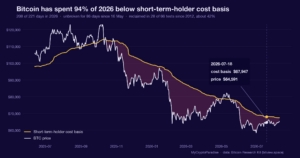
Watch how the news landed. A genuine institutional positive hit the wire, and liquidity still drained from the majors. Bitcoin holds near 59,596 but the 24-hour change is negative. Ether is down 5.2 percent, leading lower. When the larger cap holds firmer and the second name bleeds harder, that is risk coming off the table from the outside in. Alts sit at the end of that chain. They feel every drop in liquidity first and recover last. So the cascade reads cleanly: macro caution first, Bitcoin grinds, Ether leads down, alts thin out. The Invesco stablecoin filing should have been a spark. It was not. That tells us where the pressure sits. With retail participation near a six-year low, the daily flow is dominated by larger players. They trade spot, not hype. They are not buying a headline. They are waiting. The absence of a relief rally on real adoption news is itself the signal. It shows demand is not yet ready to absorb supply at these prices. Liquidity is being pulled toward lower levels where bigger hands intend to step in. Until that demand shows up, every bounce is a place to sell into, not a base to build on. The structure stays heavy while the long-term story improves.
Levels that confirm or kill the bounce
Keep it simple and watch demand, not headlines. The first thing to track is whether any bounce can clear and hold above prior resistance, or whether it stalls and rolls over. A push toward the higher zone that fails would confirm sellers remain in charge. The second thing is volume. We want to see if spot accumulation volume starts printing higher highs as price works into the lower zone. That is the footprint of real buyers, not derivatives traders chasing leverage. The third thing is breadth of fear. A market sentiment index that stays red and below zero for an extended stretch, with at least three lower lows, points to institutional frustration peaking. That sustained red is what often precedes a true bottom, not a quick one. Invalidation of the bearish read would be a reclaim and hold of higher levels on rising spot demand, with sentiment flipping back above zero. That would say buyers arrived early and the flush is being skipped. Confirmation of the bearish read is the opposite: a weak bounce, thin spot volume, sentiment stuck red, and price drifting toward the lower reaccumulation band. The Invesco stablecoin filing does not change any of these triggers. It is a background tailwind. Price action and volume tell you when the tailwind finally meets ready demand.
How the ParadiseTeam plays this setup
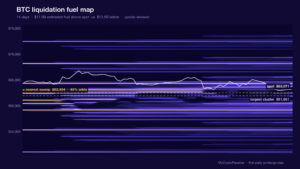
Here is how the ParadiseTeam frames the Invesco stablecoin filing against the current tape. Bitcoin trades near 59,596, just above the local low around 59,000. The filing is a long-term positive, so do not short it as bad news. Short it, if at all, as a structure trade. Our bias stays cautiously bearish: we expect a short-term bounce before a final flush. That bounce is the opportunity, not the entry to go long. The swing short region we are watching sits higher, near the 73,000 moving average and up toward the 79,000 area where a CME gap and the 786 retracement line up. A push into that zone on weak spot demand is where smart money is more likely distributing, not accumulating. The macro destination we respect is the 55,000 to 44,000 reaccumulation band. That is where larger players intend to absorb supply as over-leveraged institutions are forced out. Retail is largely gone, near a six-year low, so the panic seller this time is institutional, not the crowd. Confirmation of a real bottom needs two things together: sentiment staying red below zero with three lower lows, and higher highs on spot accumulation volume inside that band. Until both appear, the ParadiseTeam treats bounces as places to manage risk, not to chase. Probabilities, not promises. The Invesco news strengthens the long-term case while the short-term path likely points lower.
For exact entries, targets, and stop losses with full risk management, that is what ParadiseFamilyVIP is for. New to reading these moves? Start with our crypto trading strategies guide.
ParadiseTeam is monitoring the market situation closely, and we are taking these developments into consideration while building our trading tactics inside ParadiseFamilyVIP.
Crypto trading involves substantial risk. Prices are volatile and you can lose money. This article is educational and is not financial advice. Past performance does not guarantee future results.