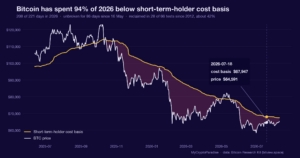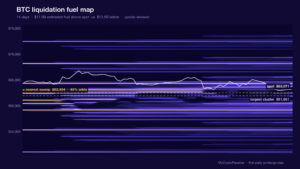
Developing story update (June 27, 2026, 07:59 UTC):
Update: the risk-off pressure has deepened since publication. Bitcoin has retested the $58,000 area, while Strategy stock (MSTR) fell roughly 10% as the broader complex absorbed an estimated $3 billion in outflows.
Ethereum, however, has printed a possible double bottom on this leg down, holding near $1,583. That pairing of heavy outflows with a tentative basing structure is the tension to watch: continued institutional selling versus an early reaccumulation signal.
What to watch now: Whether ETH defends its double-bottom level while BTC holds the $58K retest, or outflows force another leg lower.
Developing story update (June 27, 2026, 02:35 UTC):
Update: The earlier reported breach affecting Polymarket has been clarified. The attack involved malicious code injected directly into the platform’s website frontend after a third-party provider was compromised, with roughly 3 million dollars in user assets taken.
For traders, the takeaway is operational caution. Avoid interacting with the affected frontend until the platform fully confirms remediation, and treat any prompts or approvals from it as suspect in the interim.
What to watch now: Watch for an official Polymarket confirmation that the frontend is clean and the third-party provider gap is closed.
Developing story update (June 27, 2026, 01:29 UTC):
Update: STRC has since printed a fresh record low near $71, deeper than the $78.96 low noted earlier, before recovering to roughly $75.29. That marks a decline of more than 14 percent over the past five days, keeping the preferred stock well under its $100 par value.
For traders, the lower low followed by a partial bounce suggests sellers remain in control while dip buyers test the floor. The move tracks ongoing bitcoin weakness rather than any STRC-specific catalyst, so the broader trend stays the dominant read.
What to watch now: Whether STRC holds the $75 recovery zone or rolls over toward fresh lows on continued bitcoin pressure.
Developing story update (June 26, 2026, 17:57 UTC):
Update: The pressure on Strategy’s STRC preferred stock has deepened. Its 90-day correlation with bitcoin has climbed to nearly 0.70, the highest reading since the product debuted in July 2025.
A product marketed for low volatility now moving in lockstep with bitcoin suggests its stability buffer has thinned. For traders, this raises the probability that institutional stress and bitcoin price action are now feeding each other rather than staying contained.
What to watch now: Watch whether STRC's correlation with bitcoin holds near 0.70 or eases, as a tell on institutional stress.
Listen: the 2-minute breakdown
Bearish for crypto
Market briefing: Strategy's STRC preferred stock just printed a record low while BTC trades near $59,824. This is institutional pain, not retail noise, and the chain runs straight into Bitcoin and Ethereum.
- STRC hit a record low of $78.96, more than 24% below its intended $100 par value.
- MSTR fell below $100 to its lowest since February 2024 as the pressure spread.
- BTC slipped under $60,000 and ETH under $1,600 as institutional confidence cracked.
Strategy's STRC collapse just exposed institutional stress under crypto's surface, dragging BTC below $60k. Is this the capitulation smart money has been waiting for?
Something broke this week, and it did not break on the retail side. Strategy's STRC preferred stock, sold to investors as a calm, low volatility income product designed to trade near $100, fell to a record low of $78.96. It touched an all time low of $73.62 on Thursday. It traded more than 24% below its intended par value. A product built to sit still moved like a falling knife. That detail matters more than any single price print. When the boring instrument cracks, the stress is real. The damage did not stay contained. MSTR, the equity wrapped around a giant Bitcoin position, dropped below $100 to its lowest level since February 2024. Bitcoin itself fell under $60,000. Ethereum slipped under $1,600. At the same time, Binance confirmed it will stop serving EU clients from next week after failing to obtain a MiCA license, adding a regulatory shadow over an already nervous market. There is no single confirmed same day catalyst here, so we are honest about that. The STRC and MSTR breakdown is our read of where the pressure originates, not a proven cause. But the structure is clear. Institutional vehicles are bleeding, leverage is being unwound, and the people forced to sell are not the small accounts. They are the ones who once looked untouchable. That is the story under the price.
Why a quiet income product breaking matters
STRC was never meant to be exciting. It was marketed as a low volatility income product designed to trade near $100. So when it falls to $78.96 and touches $73.62, the message is not about one stock. It is about the plumbing. Income style instruments break when holders need cash and have nowhere gentle to get it. That is a liquidity signal, and liquidity is the channel that moves everything in crypto. Here is the transmission. STRC under par means the structure built around Strategy's Bitcoin thesis is under strain. MSTR below $100, its lowest since February 2024, confirms the equity market is repricing that strain in real time. When a vehicle this visible weakens, every desk holding correlated exposure trims risk. Trimming risk means selling the most liquid asset first, and the most liquid asset in this complex is Bitcoin. So institutional distress does not stay in equities. It leaks into spot through forced or defensive selling. Binance pulling EU clients after failing MiCA adds a second layer, thinning one of the largest pools of regulated liquidity right as the market needs depth. The result is a market with less cushion and more sellers. That is why a quiet product breaking par is not a footnote. It is the macro effect that sets up the liquidity effect, which then lands on BTC and ETH. The driver is institutional, and the price is simply the receipt.
How institutional selling reaches BTC then alts
Follow the cascade in order. Institutional distress comes first. STRC at a record low and MSTR below $100 force balance sheets to defend themselves. Defense means raising cash, and cash comes from the deepest market available. Bitcoin absorbs that first wave, which is why BTC fell below $60,000 and now trades near $59,824. It is the shock absorber for everyone else's stress. Ethereum sits one step down the liquidity ladder. When BTC bleeds on institutional selling, ETH usually bleeds harder, and it did, slipping under $1,600 to roughly $1,565. That is the textbook second leg: the reserve asset takes the hit, then the next largest follows. Alts are the interesting part. Some are showing minor independent bounces while the majors sag. BNB trades near $560 and Chainlink near $7.22, both modestly green on the day. Do not misread that as strength. Thin alt bounces during major weakness are usually low conviction reflex moves, not fresh demand. They are where late retail and short term traders push derivatives while spot pressure builds underneath. Retail participation is at a six year low, so the daily tape is unusually hollow. That hollowness makes moves sharper in both directions. The honest read is that this is a distribution and de risking environment, not accumulation yet. The liquidity is draining from the top down, and the bounces in smaller coins are noise on the surface of a heavier tide.
What confirms the flush versus a fakeout
Watch whether institutional stress keeps printing or starts to heal. If STRC stays well below par and MSTR holds under $100, the pressure is ongoing and the path of least resistance stays lower. A recovery back toward STRC's $100 design level would be the first sign the forced selling is exhausting itself. That is the single cleanest tell in this whole story. On Bitcoin, the level that matters near term is the reaction around current price near $59,824. A weak, low volume drift lower keeps the bearish structure intact. The thing we want to see for a real bottom is specific: an extended stretch of institutional frustration showing up as a sustained negative read, followed by higher highs on genuine spot accumulation volume inside the deeper support band. Until both appear together, bounces are suspect. Also watch the Binance MiCA exit. Pulling EU clients next week thins regulated liquidity, so any sharp move into thin books can overshoot. Treat violent spikes as liquidity events, not trend changes. Confirmation of more downside looks like ETH staying pinned under $1,600, alts losing their small bounces, and spot selling continuing. Invalidation of the bearish near term read looks like STRC repairing toward par, MSTR reclaiming $100, and BTC absorbing supply without new lows. One of those two pictures will resolve soon, and the STRC chart is the leading indicator for both.
What STRC's break means for the macro bottom
The ParadiseTeam reads this through one lens: who is being forced to act, and who is patiently waiting. STRC breaking par and MSTR falling below $100 are exactly the kind of institutional pain that precedes capitulation. Institutions that were not diligent in their strategy are now the forced sellers, and forced selling is the fuel for a final flush. With BTC near $59,824 and a current local low around $59,000, we still view the medium term picture as cautiously bearish, not yet a buy. Our framework expects a possible short term bounce toward the $73,000 to $79,000 region, where a moving average, a CME gap, and a Fib confluence sit, as a swing short opportunity into strength rather than a chase. The zone that matters for real reaccumulation is $55,000 to $44,000. That is where this STRC driven institutional stress is most likely to resolve into capitulation, and where smart money, focused on spot while retail trades derivatives, is positioned to absorb supply. The confirming signal is specific and not yet present: a sustained negative institutional read combined with higher highs on spot accumulation volume inside that band. Until then, news like this STRC collapse reinforces the thesis rather than reversing it. Retail at a six year low means the crowd is largely absent, so the people getting flushed are the leveraged institutions, not the small accounts. Probabilities, not certainties: the pain is the setup for the patient.
For exact entries, targets, and stop losses with full risk management, that is what ParadiseFamilyVIP is for. New to reading these moves? Start with our crypto trading strategies guide.
ParadiseTeam is monitoring the market situation closely, and we are taking these developments into consideration while building our trading tactics inside ParadiseFamilyVIP.
Crypto trading involves substantial risk. Prices are volatile and you can lose money. This article is educational and is not financial advice. Past performance does not guarantee future results.