Developing story update (June 27, 2026, 09:47 UTC):
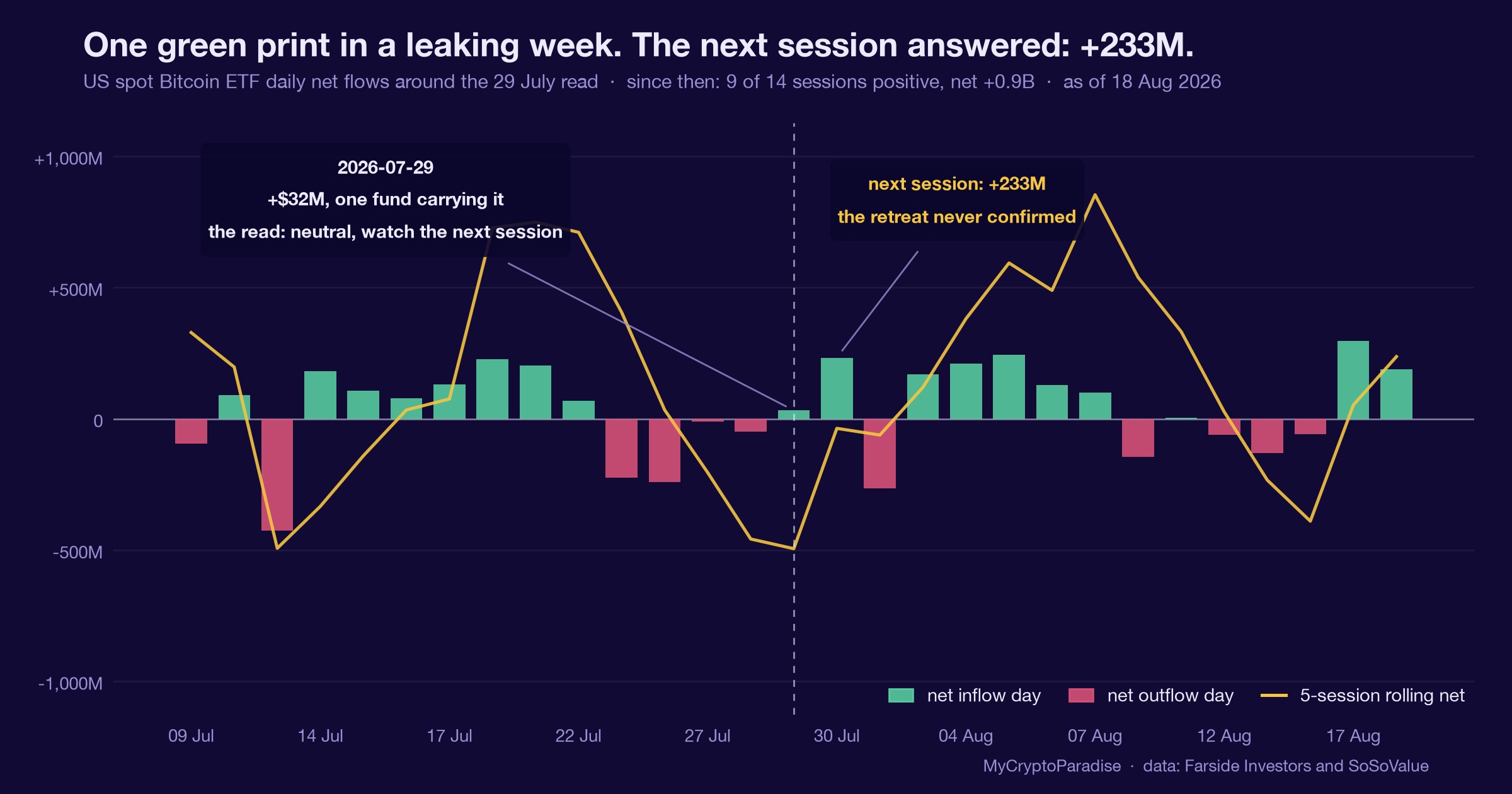
An update on the June 26 outflow picture: the day’s net Bitcoin ETF redemptions were driven entirely by a single fund, BlackRock’s IBIT, rather than spread across issuers. Concentrated selling from the largest vehicle suggests the pressure is coming from a narrow base, which can probably amplify the move if other issuers follow.
Spot prices remain fragile near $60,300 while this plays out. Traders should watch whether the concentration broadens or eases over the next sessions before reading too much into a single fund’s flows.
What to watch now: Whether outflows broaden beyond IBIT to other issuers, or the concentration eases.
Listen: the 2-minute breakdown
Market briefing: U.S. spot Bitcoin and Ethereum ETFs just posted a seventh straight day of outflows, with $445 million leaving Bitcoin funds. Bitcoin holds near $60,299 as institutional selling drains spot liquidity.
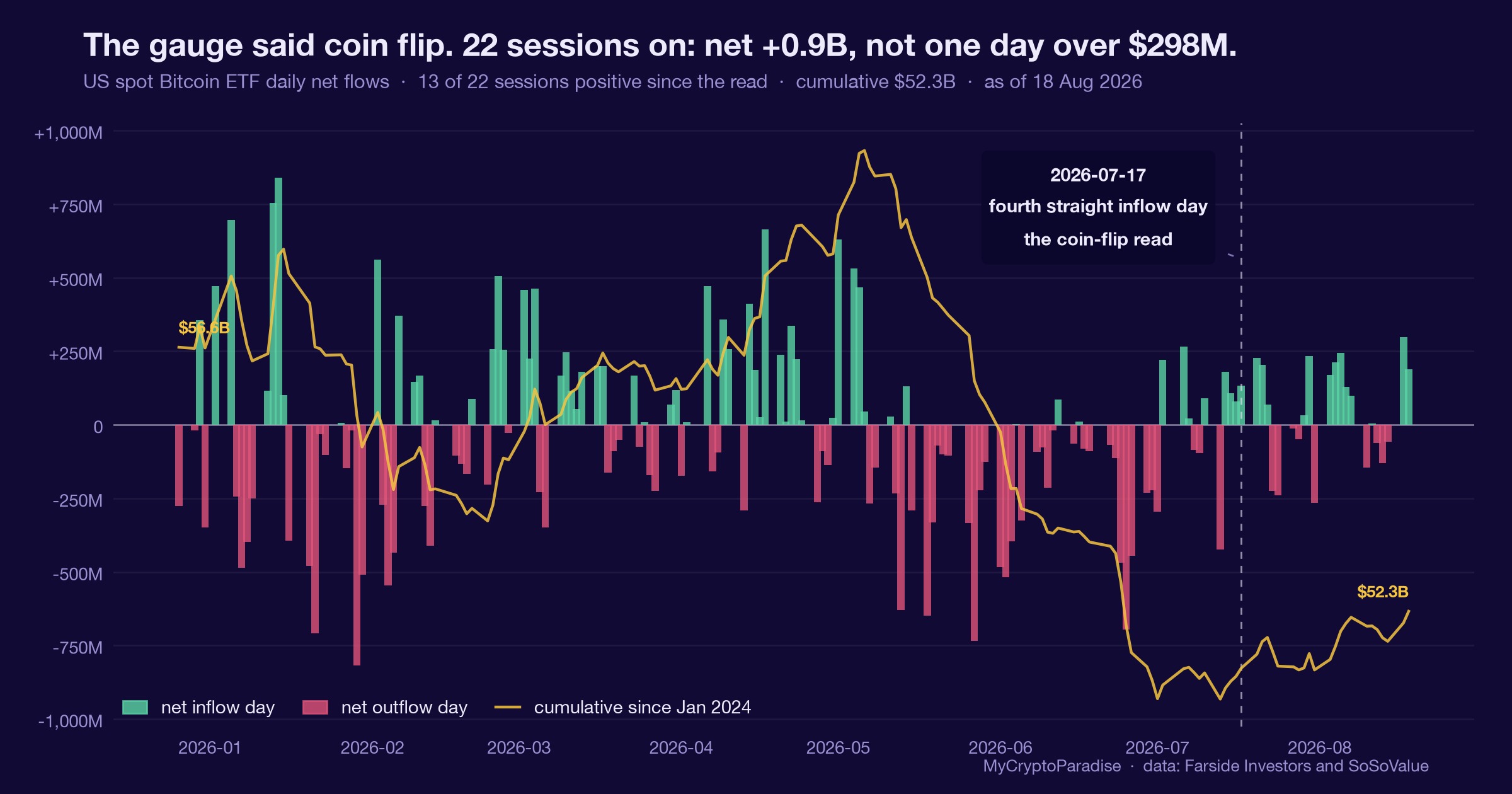
- U.S. spot Bitcoin ETFs lost $445 million on June 26, a seventh straight day of net outflows.
- June redemptions hit $3.61 billion, the largest monthly withdrawal streak since these funds launched.
- Total net assets fell below $73 billion for the first time since late 2024.
Bitcoin ETF outflows just stretched to a seventh straight day, with $445 million leaving in a single session. Is this institutional capitulation, or the start of something deeper?
U.S. spot Bitcoin and Ethereum ETFs just logged a seventh straight day of net outflows. On June 26, Bitcoin funds shed $445 million. Ethereum funds lost $12.848 million on the same day. The streak is not a blip. June redemptions for Bitcoin ETFs reached $3.61 billion. One session alone saw $696.3 million leave, the largest single-day outflow of the month. Year to date, $4.6 billion has now exited these products. This is the largest monthly withdrawal streak since the funds launched. The trailing 30 days mark the worst on record, with more than $6 billion gone. Total net assets in U.S. spot Bitcoin ETFs have slipped below $73 billion. That level was last seen in late 2024. Bitcoin trades near $60,299 as we write. Earlier today we covered the drop below $60,000 and the billion-dollar liquidation wave. This is the slower companion story. Liquidations are loud and violent. ETF outflows are quiet and patient. The first flushes retail out of leverage. The second tells you what the patient money is doing with its spot holdings. For two years the ETF was sold as steady, sticky, institutional demand. The flows now say something different. When the same products that absorbed coins on the way up start handing them back, structure changes. This is the part of the cycle where the press release and the balance sheet stop agreeing. Who is selling, who is waiting, and where the supply lands matters more than the daily red number.
Why the redemption streak drains spot liquidity
An ETF outflow is not just a headline. It is a mechanical sell order. When investors redeem shares, the fund must deliver cash. To raise that cash, the issuer sells the underlying Bitcoin. Seven days of redemptions means seven days of forced spot supply. That supply hits a market with thinner demand behind it. Macro conditions stay tight. Risk appetite is low across assets. Crypto sits at the far end of that risk curve. When money leaves risk, it leaves crypto first. The ETF was meant to be the bridge that kept institutional money in. Right now it is the exit. The $3.61 billion in monthly redemptions is real liquidity removed from the spot bid. Net assets below $73 billion show how far the air has come out. This is the transmission chain. Tight macro drains risk appetite. Risk-off triggers ETF redemptions. Redemptions force spot selling. Spot selling pressures price. Price weakness feeds more fear. The loop is self-reinforcing while it lasts. It matters because spot is the foundation. Retail trades derivatives and gets liquidated. Institutions hold spot and move slowly. When the slow money sells spot for seven days running, the floor under the market softens. That is the structural shift behind the quiet number. The daily figure looks small. The streak is the signal.
How outflows ripple from Bitcoin to alts
Start with the liquidity. Every redeemed share removes a buyer and adds a seller. Market makers widen spreads when flow turns one way. Spot depth thins. That is the setup for sharper moves on smaller volume. Bitcoin feels it first. It is the largest holding and the deepest book. The $445 million in a single day still leaves a mark when demand is absent. Price near $60,299 sits just above the local low around $59,000. The cushion is thin. Ethereum comes next. Its outflow was smaller at $12.848 million, and ETH actually rose 2.1% to $1,580.14 on the day. But ETH liquidity leans on Bitcoin liquidity. When BTC books thin, ETH follows with a lag. Alts sit at the end of the chain. They carry the least depth and the most leverage. When spot drains at the top, alts gap hardest at the bottom. A 5% move in Bitcoin can become a 15% move in a mid-cap. This is why the cascade order matters. Money leaves the ETF. Bitcoin spot absorbs the first hit. Ethereum tracks it down. Alts amplify it. The number of crypto investors sits near a six-year low. Thin participation makes each leg more violent. Less liquidity means bigger candles in both directions. The outflow streak is the fuel. The thin book is the accelerant.
Signals that confirm a real bottom
Watch the flow first. One green day does not end a seven-day streak. A genuine turn needs several sessions of net inflows, not a single bounce. If redemptions slow and reverse, the forced-seller pressure eases. That is the first sign the worst supply is behind us. Watch the price levels next. Bitcoin holds near $60,299 above the $59,000 local low. A clean break below $59,000 opens the door to the deeper zone. We are watching $55,000 down to $44,000 as the area where patient capital tends to wait. A flush into that band, on heavy volume, would fit the capitulation script. Watch the divergence. We track institutional flow indices for a sustained move below zero. At least three lower lows there signals real frustration, not noise. Pair that with higher highs on spot accumulation volume inside the $55,000 to $44,000 zone. That combination is what marks a macro bottom, not a guess. Invalidation runs the other way. Strong, repeated ETF inflows plus a reclaim above the $73,000 region would argue the de-risking ended early. Until then, the path of least resistance stays lower. Be honest about what is confirmed. The outflows are fact. The bottom call is a read, not a certainty. Markets rarely ring a bell. They leave footprints in the flow data instead. Watch the footprints, not the forecasts.
What seven days of selling reveals
The ParadiseTeam reads this streak as confirmation, not surprise. We expected institutions that were never diligent in their strategy to be forced sellers. Seven days of redemptions and a record monthly streak are that selling, in public. Bitcoin near $60,299 still sits above where we want to act. Patient money does not chase a falling knife. It waits for the supply to land. Our reaccumulation zone stays $55,000 to $44,000. That is where forced sellers usually exhaust. Before that, we see room for a relief bounce. The $73,000 region, near a key moving average, and $79,000, near a CME gap and the 786 retracement, are the levels we watch on the way up. A bounce into that band would meet supply, not demand. That is distribution territory, not a new uptrend. The current local low sits around $59,000. Lose it with conviction and the deeper flush gets more likely. Hold it and the relief move has room. The tell we want is specific. An institutional flow index below zero for a sustained stretch, three lower lows or more, paired with higher highs on spot accumulation volume inside the macro zone. That confluence, not a single green ETF day, is what would shift our stance. Retail has largely left, with investor counts near a six-year low. Thin crowds make the bottom messy. The ParadiseTeam stays patient and lets the supply come to the level.
For exact entries, targets, and stop losses with full risk management, that is what ParadiseFamilyVIP is for. New to reading these moves? Start with our crypto trading strategies guide.
ParadiseTeam is monitoring the market situation closely, and we are taking these developments into consideration while building our trading tactics inside ParadiseFamilyVIP.
Crypto trading involves substantial risk. Prices are volatile and you can lose money. This article is educational and is not financial advice. Past performance does not guarantee future results.