Developing story update (June 27, 2026, 11:36 UTC):
Update: the selling pressure has now pushed Bitcoin to a fresh 20-month low near $59,200 before the price recovered back above $60,000. This marks a deeper local capitulation point than when we first reported.
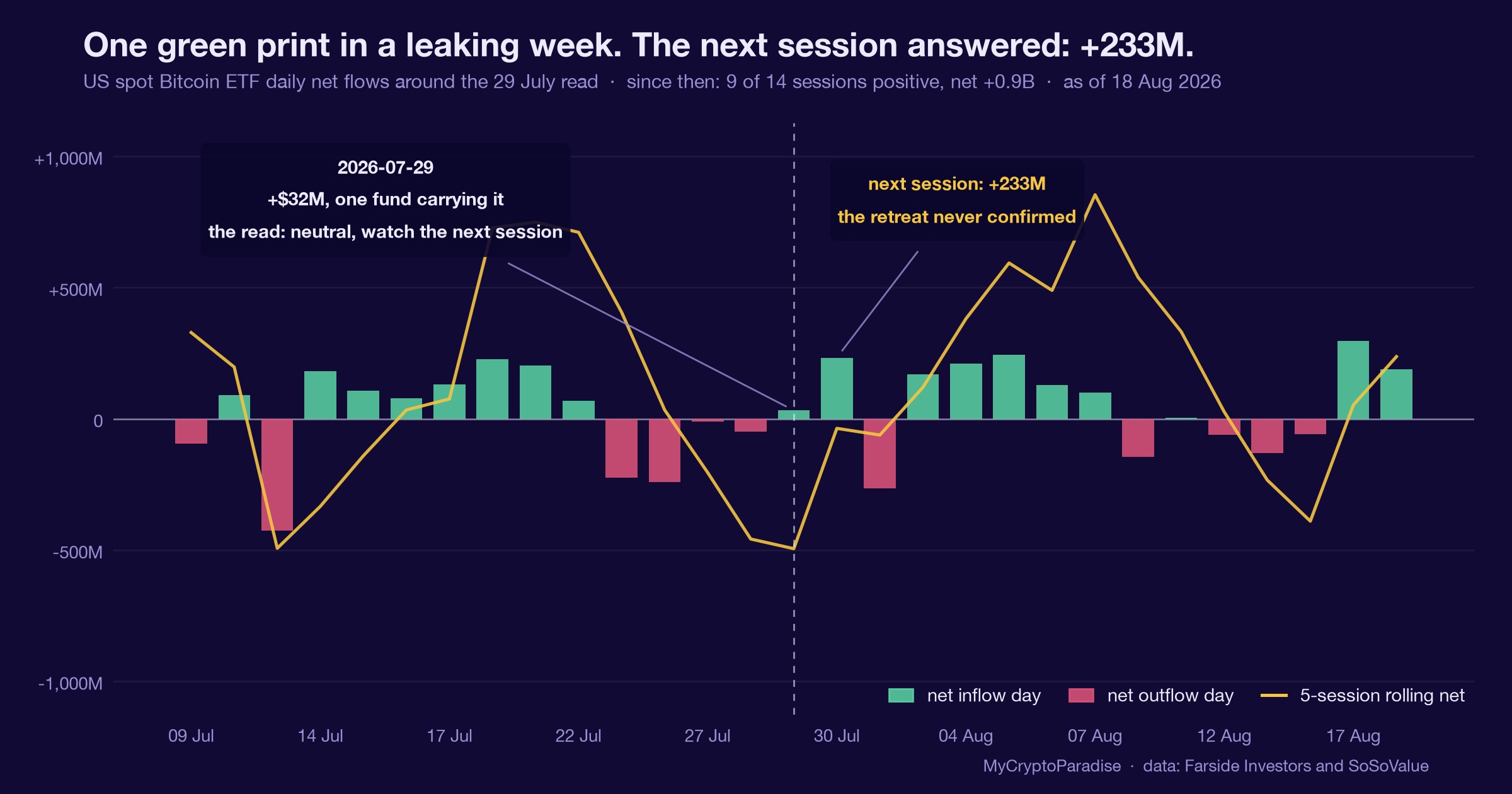
Net outflows across the week now sit near $1.79 billion, confirming the six-day institutional withdrawal streak is broadening rather than easing. The $55,000 to $44,000 macro bottom zone remains the area where smart money is likely waiting to absorb supply.
What to watch now: Whether $59,200 holds as support or breaks toward the $55,000 to $44,000 reaccumulation zone.
Developing story update (June 27, 2026, 09:04 UTC):
The picture has widened beyond the single record week. June’s total spot Bitcoin ETF outflows have now reached $3.61 billion, and year-to-date net outflows stand at $4.6 billion, framing the recent selling as part of a longer institutional unwind rather than a one-off.
Thursday’s $696.3 million daily exit also cleared the prior monthly peak of $519.2 million set on June 2, confirming the pace of redemptions is accelerating, not easing.
What to watch now: Watch whether daily outflows keep printing fresh monthly highs or the streak breaks as price tests the lower reaccumulation zone.
Developing story update (June 27, 2026, 07:38 UTC):
Update: Fresh data confirms Bitcoin printed a 20-month low of $59,200 on Wednesday before steadying near $60,300, deepening the move tied to the recent ETF outflow streak.
For traders, that fresh low reinforces the sustained selling backdrop rather than signaling a clean reversal. It keeps the focus on whether spot demand can absorb supply near these levels or whether price probes lower into the reaccumulation zone.
What to watch now: Whether the $59,200 low holds or price probes deeper toward the $55,000 to $44,000 reaccumulation zone.
Listen: the 2-minute breakdown
Market briefing: Spot Bitcoin ETFs just logged their worst single day of June, near 696 million dollars out, as BTC holds 60,211 below the 60,000 line it briefly lost. The capital is rotating, not resting.
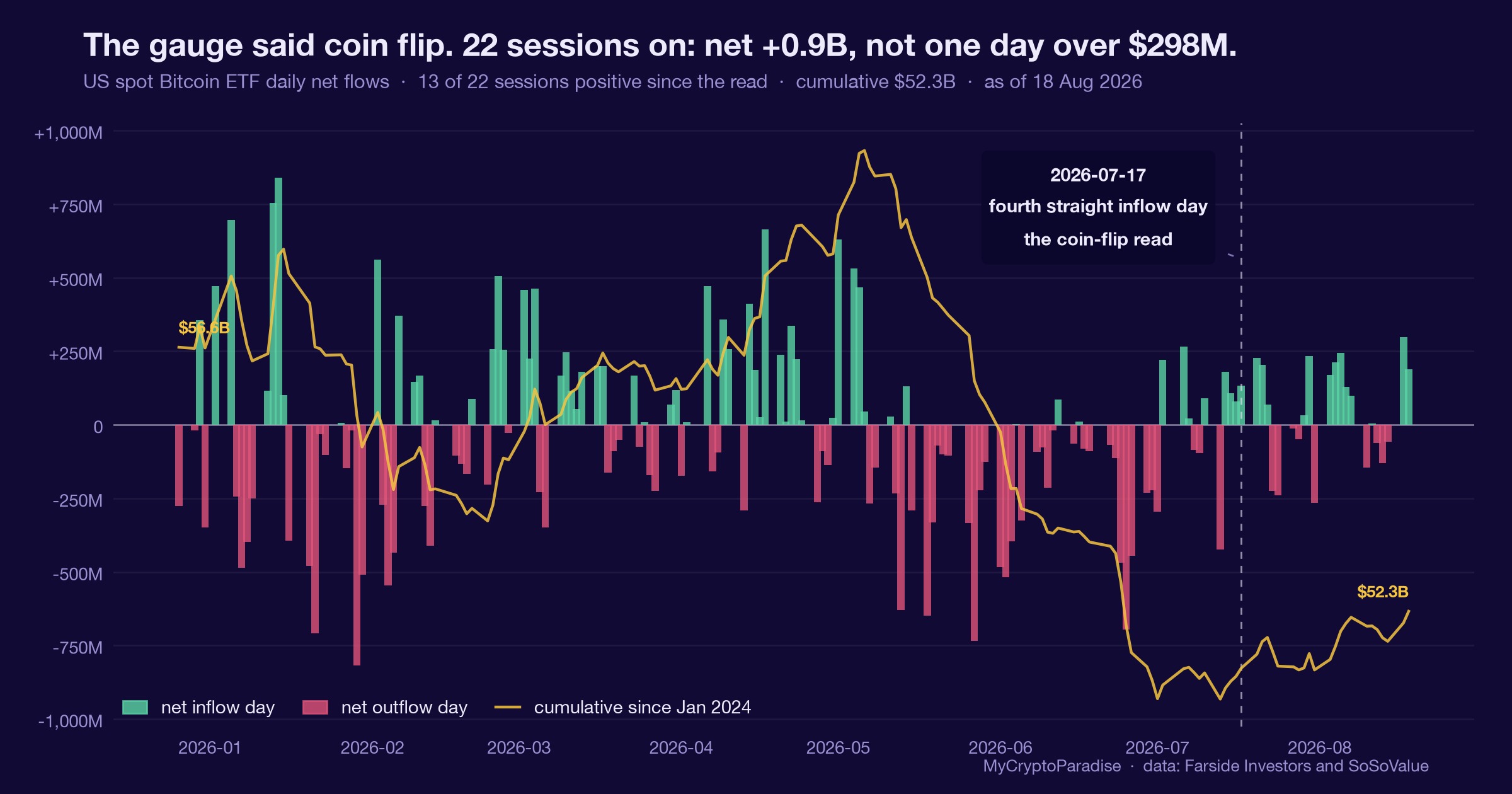
- Spot Bitcoin ETFs posted June's largest daily net outflow on Thursday, near $696.3 million.
- Outflows ran six days straight, with almost $1.2 billion leaving over the last two sessions.
- BlackRock's IBIT alone saw a $265.2 million outflow as BTC slipped under $60,000.
Bitcoin ETF outflows just printed June's ugliest single day, near $696.3 million gone as BTC clings to $60,211. So who is actually doing the selling?
We have already tracked the streak this week. The outflows kept going, and Thursday made it official. US spot Bitcoin ETFs recorded their largest daily net outflow of June on June 25, roughly $696.3 million in a single session. That is the new line in the sand, and it is worth pausing on. This was the sixth consecutive day of net outflows. Over the last two sessions alone, nearly $1.2 billion left these funds. BlackRock's iShares Bitcoin Trust, the giant that usually absorbs supply, posted a $265.2 million outflow of its own. When the biggest buyer becomes a seller, the structure changes. Price followed the flow. Bitcoin slipped below the $60,000 threshold on June 25 and now trades at $60,211, barely changed on the day. The number that matters is not the 24-hour move. It is the direction of the money behind it. What looks like a quiet tape is actually a slow institutional exit. The same vehicles that were sold as patient, long-term capital are reducing exposure six days running. Markets love a tidy story about diamond hands. The flows tell a different one. This is not a panic crash. It is a measured rotation, and that is precisely why traders should pay attention. The driver here is simple to name and easy to underestimate: capital is leaving Bitcoin ETFs, and it is doing so steadily.
Why steady ETF selling reshapes demand
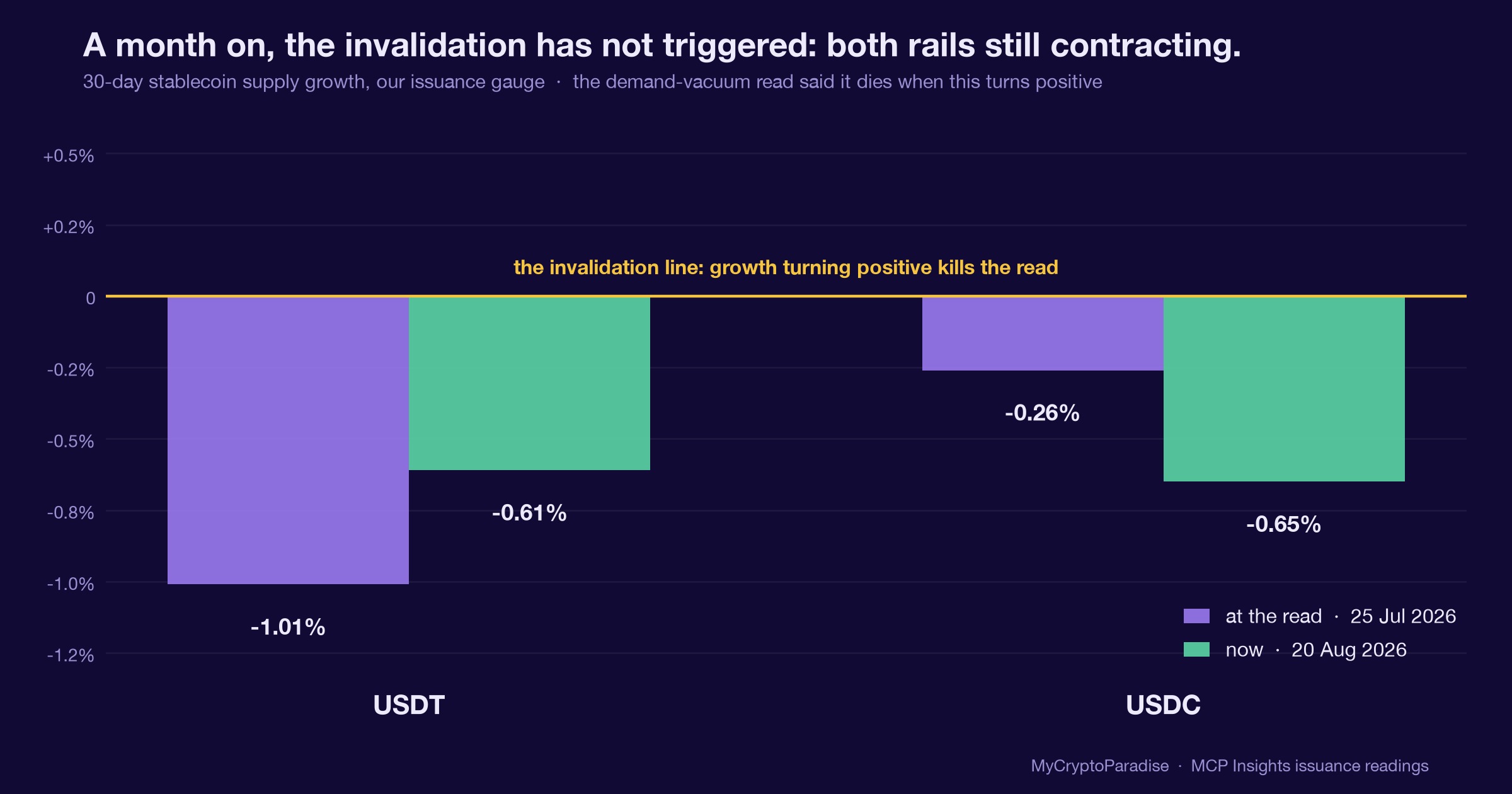
Start with the transmission. Spot Bitcoin ETFs are the cleanest pipe between traditional capital and BTC. When money flows in, the issuer buys spot Bitcoin. When money flows out, the issuer sells. So six straight days of outflows is not sentiment. It is mechanical selling into the market, day after day. Nearly $1.2 billion over two sessions is real supply hitting real order books. Now layer the macro read, which is ours, not a confirmed fact. Capital appears to be rotating toward AI-linked equities and other traditional assets. Institutions chasing yield and momentum elsewhere reduce their marginal demand for spot Bitcoin. That is the second-order effect. Less inflow plus active outflow equals a demand vacuum at exactly the moment price needs buyers. This is the part the headline mood misses. The first-order effect of outflows is bearish, and we read it that way. But the deeper signal is who is leaving. Some of these institutional positions were never patient. They were trend-following allocations, and trends cut both ways. When the diligent money sees forced sellers ahead, it does not rush to catch the falling supply. It waits. The structure that built BTC's rally is loosening one trading day at a time. For a strategist, the lesson is plain: respect the flow before you respect the forecast. The pipe is running one direction, and price is obeying it.
How the outflow pressure travels through BTC
Trace the cascade. The selling starts at the top of the stack, in Bitcoin itself, because that is what the ETFs hold. Sustained issuer selling pressures spot, and spot is where the real price lives. BTC losing $60,000 on June 25 was the visible symptom. The cause was the flow underneath it. From there the pressure spreads outward. When the largest, most liquid asset bleeds, liquidity tightens across the board. Market makers widen spreads. Risk desks trim books. Ethereum tends to feel it next, since ETH trades as the high-beta cousin of BTC in risk-off windows. Then the altcoins, which have no ETF pipe of their own, get dragged by thinner liquidity and falling confidence. They fall faster than Bitcoin on the way down, as they almost always do. Notice what is absent from this picture. Retail is not the seller here. The number of active crypto investors sits near a six-year low, and everyday traders mostly play derivatives, not spot ETFs. So this is an institutional story, not a crowd story. That distinction matters for what comes next. A retail panic flushes quickly and bounces hard. A measured institutional exit grinds. It does not produce a single dramatic candle to buy. It produces a steady, uncomfortable drift that wears positions out. The current calm 24-hour move, with BTC at $60,211, fits that grind perfectly.
What would confirm or break the downtrend
Watch the flow first, price second. The single most important signal is whether outflows continue into a seventh and eighth day or finally stall. A clear shift back to net inflows would tell us the diligent money sees value and is stepping in. Until then, treat bounces with suspicion. The level to respect on the downside is the $60,000 region BTC just lost. As long as price struggles to reclaim and hold above it, the path of least resistance points lower. Below that, our framework looks toward a deeper zone for genuine absorption, which we detail in the next section. On the upside, the invalidation for the bearish read is not a small green candle. It is a sustained reclaim of lost ground on rising spot accumulation volume, not derivatives froth. Volume tells you whether a bounce is real buyers or just shorts covering. Also watch the rotation story. If AI equities cool and capital looks for a home, some of it may circle back to Bitcoin. That would be the macro tell. For now the confirmation runs bearish: outflows persisting, BTC capped under $60,000, and any rally fading on weak volume. The invalidation runs bullish: inflows resuming, $60,000 reclaimed with conviction, and spot volume expanding into strength. Let the data pick the side. The tape is honest if you let it speak.
Reading the exodus through smart money
Here is how the ParadiseTeam frames this for traders. With BTC at $60,211, just under the $60,000 line and sitting at a local low near $59,000, this is not yet the place we get aggressive on the long side. Our read stays cautiously bearish in the near term, inside a longer macro reset. The institutional outflows are the capitulation engine. We expect that pressure to push price toward our reaccumulation zone of $55,000 to $44,000, the area where patient capital is positioned to absorb supply. Until price reaches it, we treat strength as opportunity, not as a bottom. A short-term bounce toward the $73,000 moving average or the $79,000 CME gap and 786 retracement would be the classic spot for a swing short, where trapped longs and forced sellers meet thinning demand. Those are levels to watch, not promises. The mechanism is the point: less diligent institutions selling at a loss, smart money waiting below, retail largely absent from the spot tape. We want confirmation of the macro bottom before flipping bias, specifically higher highs on spot accumulation volume inside the $55,000 to $44,000 band. Until that prints, bounces are likely distribution, not accumulation. This is news analysis, not a signal. Position with risk first, size for being wrong, and let the flow confirm the read.
For exact entries, targets, and stop losses with full risk management, that is what ParadiseFamilyVIP is for. New to reading these moves? Start with our crypto trading strategies guide.
ParadiseTeam is monitoring the market situation closely, and we are taking these developments into consideration while building our trading tactics inside ParadiseFamilyVIP.
Crypto trading involves substantial risk. Prices are volatile and you can lose money. This article is educational and is not financial advice. Past performance does not guarantee future results.