Developing story update (June 27, 2026, 10:53 UTC):
Update: The monthly picture is now clearer. June ETF outflows totaled $3.61 billion, with the heaviest single day reaching $696.3 million on Thursday.
Year to date, net outflows now stand at $4.6 billion. Bitcoin is holding just under $60,000, and a continued pace at these levels would keep pressure on supply absorption into the lower zone we are watching.
What to watch now: Whether daily outflows keep building on June's $3.61 billion pace or start to taper as price stabilizes near $60,000.
Developing story update (June 27, 2026, 09:27 UTC):
Fresh data sharpens the picture: the bleed includes nearly $1 billion in combined net outflows across two consecutive recent days, and roughly 63,500 BTC have left these funds over the past 30 days.
The slowdown in fresh buying is just as telling. ETF accumulation fell to about 3,600 BTC in June, down from 25,000 BTC in May. That points to fading institutional demand, not just profit-taking, and it keeps probabilities tilted toward more downside pressure before a base can form.
What to watch now: Watch whether daily ETF buying stays suppressed near June's 3,600 BTC pace or recovers toward May levels.
Listen: the 2-minute breakdown
Market briefing: Bitcoin ETF outflows reached 1.34 billion this week and over 6 billion in 30 days, the worst stretch on record, as BTC trades near 60,256. We read this as unfinished institutional capitulation, not the bottom yet.
- Bitcoin ETF outflows reached 1.34 billion this week and over 6 billion across 30 days
- A 13-day outflow streak marks the worst 30-day period since ETFs launched in 2024
- BTC trades near 60,256 after slipping below the 60,000 threshold
Bitcoin ETF outflows just printed their worst 30-day stretch on record, over 6 billion gone. Is this institutions panicking, or smart money getting handed cheap supply?
The numbers are no longer a blip. Bitcoin ETF outflows reached 1.34 billion this week alone. Stretch the lens to 30 days and the figure climbs past 6 billion. That makes it the worst monthly period for these products since they launched in 2024. Thursday delivered the single ugliest day of June, with 696.3 million withdrawn. The streak now runs 13 sessions. Bitcoin, predictably, slipped below the 60,000 threshold and sits near 60,256 as this is written. We have already covered the worst single day and the early days of this streak. The new story is the cumulative scale. One bad day is noise. Thirteen in a row, the worst month on record, is a pattern. These are the same institutions that arrived last year promising disciplined long-term allocation. Many of them are now selling at a loss. The press releases said diamond hands. The flow data says otherwise. What changed structurally is who holds the marginal coin. Retail has largely left the building, with daily participation near a six-year low. The selling pressure is institutional, mechanical, and visible. That matters because it tells us where the supply is coming from, and who is likely to be waiting on the other side of it.
Why the worst month on record matters
Outflows are not just sentiment. They are forced supply hitting the market. When an ETF sees redemptions, the issuer must sell the underlying Bitcoin to meet them. Multiply that across 1.34 billion this week and over 6 billion this month, and the transmission becomes clear. Reduced institutional demand removes a steady buyer. Mechanical redemptions then add a steady seller. The two combine to drag spot prices lower. The chain is simple. Record outflows lead to institutional capitulation. Capitulation leads to forced selling. Forced selling lowers spot prices. Lower prices drag the broader crypto market down with Bitcoin. The detail that matters is who is doing the selling. This is not retail flushing leveraged positions. Retail has mostly disappeared, with participation at a six-year low. This is institutional money, much of it deployed without a disciplined plan, now being squeezed out at a loss. That is a different kind of supply. It is patient money turning impatient. For a strategist, the size and persistence of these outflows are the real signal. A 13-day streak is not a reaction to one headline. It is a slow, grinding exit. That grind is what sets up the next phase, because every forced seller eventually runs out of coins to sell.
How the selling cascades from BTC to alts
The impact starts with Bitcoin and radiates outward. BTC absorbed the redemptions first, which is why it broke below 60,000 and now hovers near 60,256. As the anchor asset weakens, liquidity drains from everything priced against it. Ethereum tends to follow Bitcoin lower, usually with a slight lag and a sharper move. Alts come last and fall hardest, because they are the thinnest part of the market and the first thing traders cut when fear rises. That is the standard cascade, and the ETF outflows are feeding the top of it. The important nuance is where the pressure sits. With retail largely absent, there is little fresh buying to cushion the descent. The bid is thin. That makes each wave of forced selling more effective at moving price. It also means the market is unusually clean. There is no crowd to fight. When institutions are the dominant seller and retail is gone, price discovery becomes a negotiation between forced sellers and patient buyers. Right now the forced sellers have the upper hand. That is why we are not calling a bottom here. The cascade still has room to run while the outflow streak remains intact. The market is doing exactly what a market does when one side is compelled to sell and the other side is content to wait.
What confirms more downside versus a turn
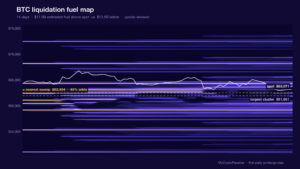
The first thing to watch is the outflow streak itself. If redemptions continue and the daily figures stay heavy, the selling pressure is intact and lower prices remain the path of least resistance. A clear break and hold below 59,000, the current local low, would confirm the trend is not done. The deeper target on our map is the 55,000 to 44,000 zone, where we expect the real work to happen. What would change the read is exhaustion. Watch for outflows to slow, then stall, then reverse into inflows. That shift signals the forced selling is ending. Equally important is spot behaviour inside the lower zone. We are watching for higher highs on spot accumulation volume specifically within 55,000 to 44,000. Paired with a market-wide index that has gone red below zero for a sustained stretch, at least three lower lows, that confluence is what historically marks a macro bottom. Until both appear, treat bounces with suspicion. A short-term relief rally is likely and even healthy, but it does not invalidate the larger picture. Invalidation would be a sustained reclaim with genuine spot buying conviction, not a thin bounce on low volume. The cleanest tell remains the flow data. When institutions stop being the seller, the structure changes. Until then, the burden of proof sits with the bulls.
What record outflows signal about who buys next
The ParadiseTeam reads this as capitulation in progress, not capitulation completed. With BTC near 60,256, the worst 30-day outflow on record tells us institutions are being forced out, exactly the supply event we have been waiting for. But the price is still above our reaccumulation zone of 55,000 to 44,000. That gap is the point. The forced selling is creating supply, but smart money does not chase it here. It waits lower. Our bias remains cautiously bearish over the near term. We expect the possibility of a short-term bounce, and we view a move back toward the 73,000 area, near a key moving average, or 79,000, near a CME gap and the 786 retracement, as the kind of level where patient capital would rather sell strength than buy it. Below, the local low at 59,000 is the line that keeps the pressure honest. The mechanism is straightforward. Retail is gone at a six-year low. Institutions are the marginal seller. When that seller is exhausted inside 55,000 to 44,000, and we see higher highs on spot accumulation volume there, the macro bottom comes into view. Until then, the outflows are a feature of the descent, not the end of it. Probabilities, not certainties. The structure favours patience over heroics.
For exact entries, targets, and stop losses with full risk management, that is what ParadiseFamilyVIP is for. New to reading these moves? Start with our crypto trading strategies guide.
ParadiseTeam is monitoring the market situation closely, and we are taking these developments into consideration while building our trading tactics inside ParadiseFamilyVIP.
Crypto trading involves substantial risk. Prices are volatile and you can lose money. This article is educational and is not financial advice. Past performance does not guarantee future results.