Listen: the 2-minute breakdown
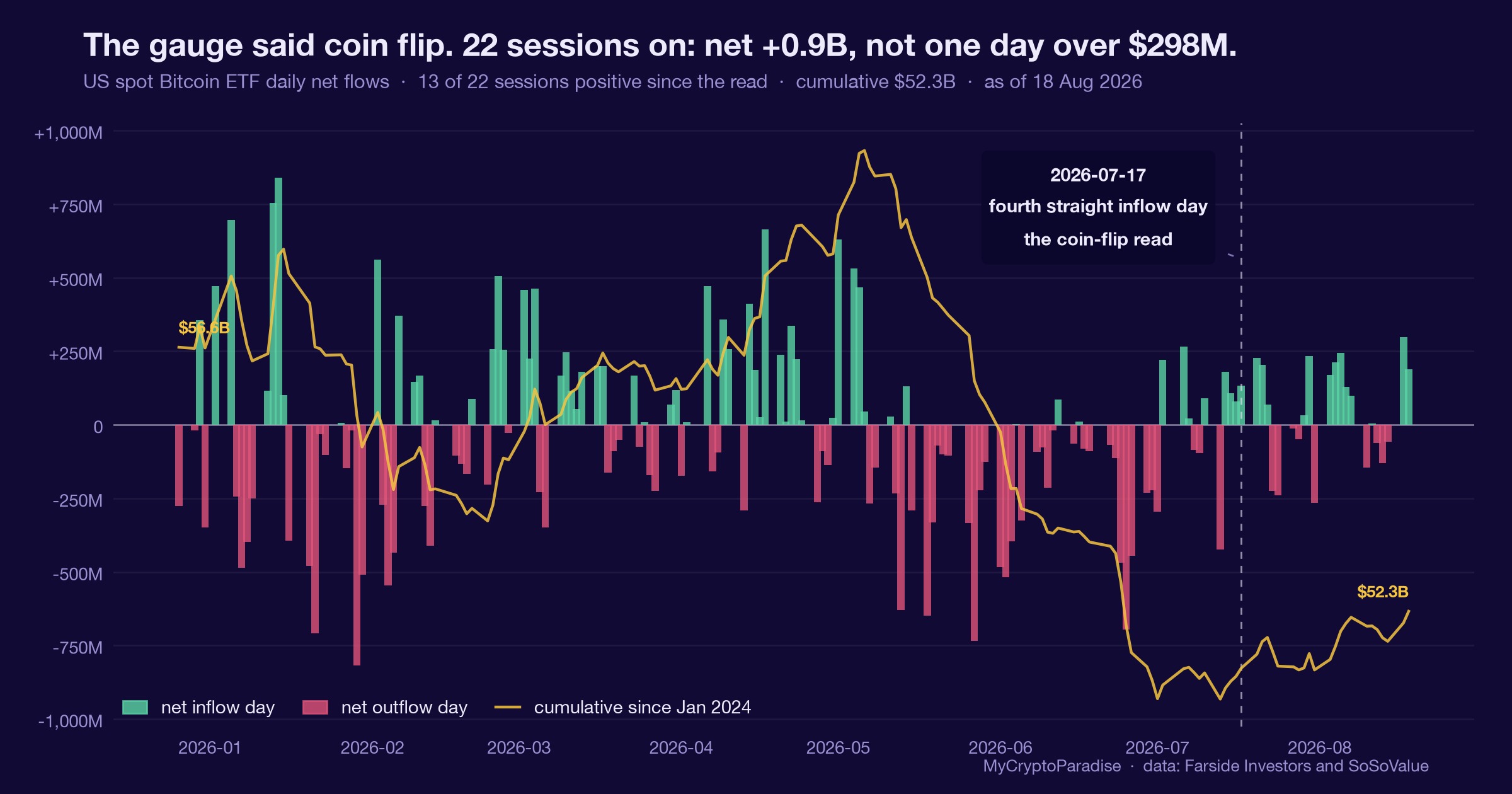
Market briefing: The average IBIT investor is now down about 40 percent, and spot Bitcoin ETFs just booked their second worst week on record with roughly 1.79 billion dollars in outflows. Bitcoin trades near 60,190, and we read this washout as retail exhaustion rather than the start of something worse.
- The average BlackRock IBIT investor is now down about 40 percent, after sitting up near 30 percent in mid 2025.
- U.S. spot Bitcoin ETFs shed roughly 1.79 billion dollars last week, the second worst weekly outflow on record.
- Bitcoin trades near 60,190, and we read the IBIT investor pain as late stage retail capitulation, not fresh danger.
The average IBIT investor is now down about 40 percent and spot ETFs just had their second worst week ever. So who exactly is selling, and to whom?
The numbers are blunt. The average investor in BlackRock's IBIT, the largest spot Bitcoin ETF, is now down about 40 percent. As recently as mid 2025 that same average investor was up around 30 percent. The round trip happened in roughly a year. Over the latest week, U.S. spot Bitcoin ETFs bled approximately 1.79 billion dollars. That ranks as the second worst weekly outflow since these products launched. The reason is not complicated. Bitcoin fell, and the people who bought the ETF near the highs are now selling near 60,190. This is the part of the cycle the glossy launch decks rarely mention. The ETF was sold as easy, regulated access to Bitcoin. It delivered exactly that. It also delivered every percent of the drawdown to people who had never sat through one. There is no single confirmed catalyst behind this specific week, so we will be honest about that. What we can see is the behaviour. Money that arrived late, during the comfortable part of the move, is now leaving during the uncomfortable part. The structure underneath matters more than the headline loss. ETF flows are a clean window into newer, less experienced capital. When that window shows record outflows and a 40 percent average loss, it usually means weak hands are being shaken out. The question for traders is not whether retail is hurting. It clearly is. The question is what professional capital does with the supply those sellers are handing over.
Why ETF outflows reveal who is selling
Spot ETFs changed the plumbing of this market. They turned Bitcoin exposure into something a retirement account could hold. That convenience has a cost, and we are watching it land. ETF flows are a remarkably honest signal. The buyers tend to be newer, slower and more emotional than native crypto traders. When IBIT investors are down 40 percent on average and the week books 1.79 billion dollars of outflows, that is not patient capital rebalancing. That is fear leaving the building. The transmission runs through liquidity. Every dollar that exits an ETF forces the issuer to sell underlying Bitcoin into the spot market. That selling pressure is real and it is mechanical. But it is also finite. Forced sellers are, by definition, sellers who eventually run out of coins to sell. The macro read is that this outflow wave represents exhaustion rather than information. Nothing fundamental about Bitcoin changed because the average IBIT investor panicked. What changed is who holds the coins. Supply is moving from people who bought a narrative to people who price risk for a living. This is the unglamorous engine of every cycle. New money buys late, sits through pain it did not expect, and surrenders its position near the lows. The 40 percent figure is the receipt. For traders, the relevant question is whether the selling is closer to its beginning or its end. The flow data, the loss profile and the location of price all point toward late, not early.
How the outflows ripple from Bitcoin to alts
Start with Bitcoin, because the ETFs hold Bitcoin and the pressure begins there. Roughly 1.79 billion dollars of outflows forced spot selling into an already nervous tape. Yet price sits near 60,190, broadly holding rather than collapsing. That is the first tell. When record outflows fail to produce a violent breakdown, it suggests a buyer is absorbing the supply on the other side. The liquidity sitting below recent lows is exactly where forced and emotional sellers cluster their stops. Those pools are magnets. Smart money knows precisely where panic lives. From Bitcoin, the effect cascades. Ethereum tracks the larger asset's stress, and liquidity thins as risk appetite drops. The alts feel it last and hardest, because they trade on borrowed confidence. When ETF holders capitulate, the marginal buyer for smaller coins simply steps back. That is why alts tend to bleed quietly during these phases while Bitcoin grabs the headlines. The mechanism to watch is the squeeze setup forming underneath. Retail is short or out. Newer ETF capital has surrendered. Positioning has grown one sided. Markets rarely reward the obvious trade once everyone has crowded into it. If Bitcoin holds this zone while outflows continue, the people pressing the downside are the ones left exposed. The cascade that started with ETF selling can reverse just as mechanically, with trapped shorts and absent buyers becoming the fuel for a sharp move back up.
What confirms the bottom and what breaks it
The honest position is that this is a probability read, not a prediction. We are weighing evidence, and the evidence can shift. On the confirmation side, the first thing we want is a daily candle that closes green and above 60,000. That tells us the zone where ETF sellers gave up is now being defended. A reclaim of the 60,300 area would strengthen that case, because it sits at a level where structure tends to flip. Volume matters here. A bounce on thin volume is noise. A bounce that arrives with conviction, while ETF outflows are still being reported, is the classic divergence between price and sentiment that marks exhaustion. Momentum turning up underneath price would add weight. On the invalidation side, we respect the downside honestly. If Bitcoin loses 58,000 with force, the bulls defending the bottom are in trouble, and the next meaningful support sits lower near 54,000. A break that gathers pace rather than getting bought would tell us the capitulation is not finished and the supply from ETF holders is heavier than the demand meeting it. The cleanest tell is behaviour at the lows. If new lows keep getting bought back quickly, that is accumulation wearing the costume of weakness. If they hold and extend, the sellers still own the tape. We are not married to either outcome. We are watching which side the evidence keeps choosing as the outflows play out.
What this capitulation signals about market structure
Here is the ParadiseTeam read, applied to this exact event. A 40 percent average IBIT loss and a record outflow week are not a reason to join the panic. They are a description of who is panicking. Our working bias is bullish into a potential reversal, and this news fits that thesis rather than fighting it. The capital leaving the ETFs is the same inexperienced money that tends to be wrong at turns. With Bitcoin near 60,190, the structure we care about is intact. We want a daily close above 60,000, and ideally above the 60,300 level, to confirm the zone is being defended rather than lost. Below price, 58,000 is where the bottom is being contested, and 54,000 is the support we fall back to if it breaks. Above, 65,836 stands out, because that is where a heavily short, inexperienced position risks liquidation. That detail matters. While ETF holders capitulate, someone large is leaning hard against the move, and the stops from that short sit overhead like fuel. This is the asymmetry we are watching. Retail is selling the ETF near the lows while a crowded short presses the same direction. When sentiment and positioning agree this loudly, the market often does the inconvenient thing. We are not promising a bounce. We are saying the outflow data describes exhausted sellers, not informed ones, and that is usually where reversals are quietly built.
For exact entries, targets, and stop losses with full risk management, that is what ParadiseFamilyVIP is for. New to reading these moves? Start with our crypto trading strategies guide.
ParadiseTeam is monitoring the market situation closely, and we are taking these developments into consideration while building our trading tactics inside ParadiseFamilyVIP.
Crypto trading involves substantial risk. Prices are volatile and you can lose money. This article is educational and is not financial advice. Past performance does not guarantee future results.