In short
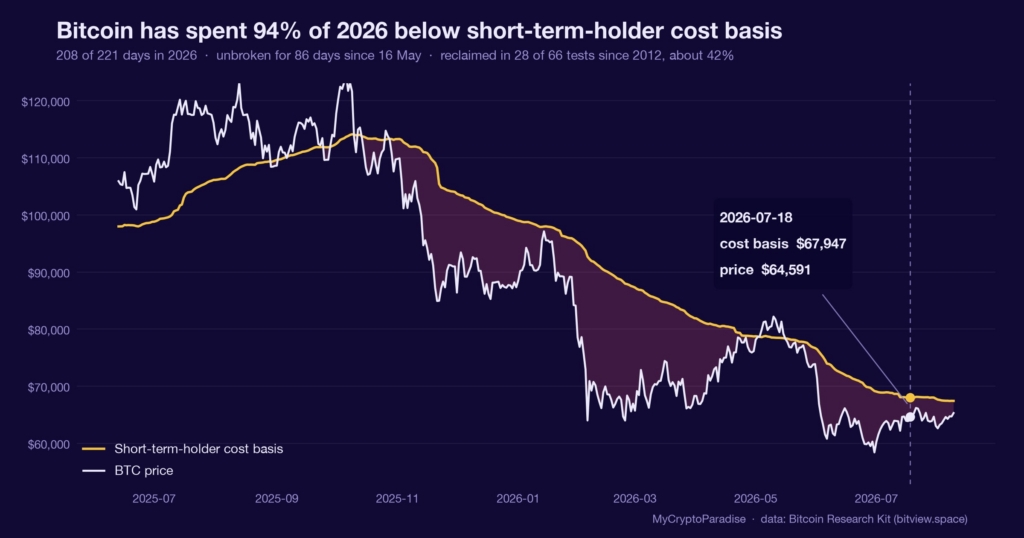
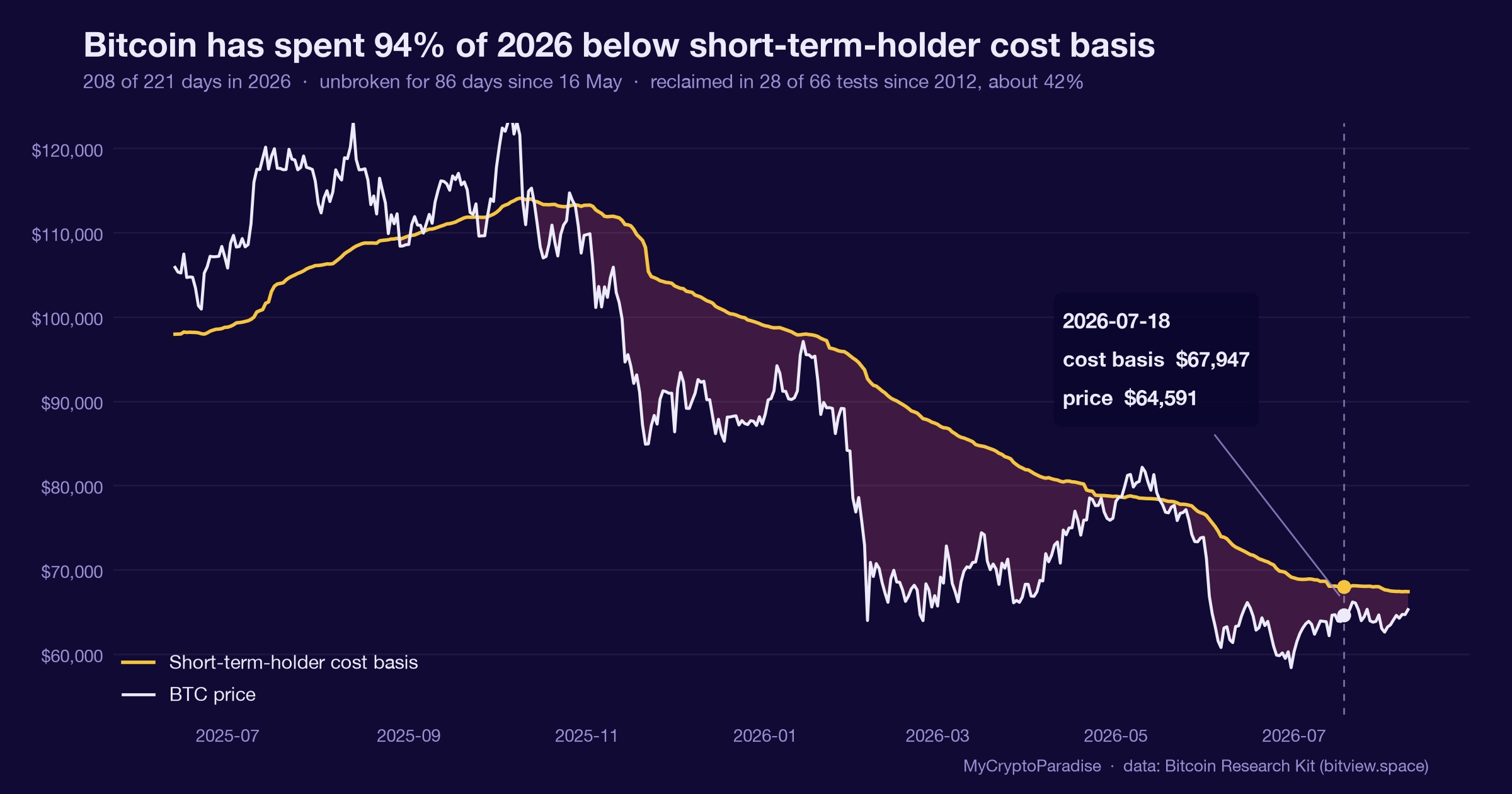
Short-term-holder cost basis is the average price paid by the wallets that bought in roughly the last six months. When spot trades below it, that whole cohort is underwater, and some of them sell. On 18 July 2026 Bitcoin sat at $64,593 against a short-term-holder cost basis of $67,948, and realised losses from recent buyers hit a record monthly average near $90 million. That looks like capitulation, and capitulation sometimes marks a floor. The honest base rate says otherwise: since 2012, price below this level has reclaimed it in about 28 of 66 tests, roughly 42 percent. Below a coin flip. This piece shows you how to read the metric yourself, what invalidates the read, and why a record loss number is not the same as a bottom.
What short-term-holder cost basis actually measures
Every coin on the Bitcoin network carries the price it last moved at. Group the coins that moved within roughly the last 155 days and average what they paid. That average is the short-term-holder cost basis.
It is a behavioural line, not a technical one. Nobody draws it. It emerges from what recent buyers actually paid.
That is why it matters more than a round number or a moving average. It marks the point where an identifiable group of people moves from profit into loss.
Above it, recent buyers are up, and selling is a choice. Below it, selling becomes a decision about pain tolerance. Those are different markets.
What the 18 July reading showed
Spot was $64,593. The short-term-holder cost basis was $67,948. The gap was 3.76 ATR, which is a wide stretch by historical standards, not a marginal dip below the line.
Per our MCP Insights cost-basis data, 52.4 percent of short-term-holder supply sat in loss. Just over half of the recent-buyer cohort was underwater.
The wallets in question bought roughly between $88,000 and $126,000. At $64,593, every one of them was holding a loss.
Realised losses from that cohort reached a record monthly average near $90 million. The on-chain Insider feed also flagged 2,450 BTC held on exchanges by top buyers sitting in loss on a 30 day average.
You can watch the live version of this on our Bitcoin cost-basis tracker, which updates the loss share as it moves.
What is different here
The ParadiseTeam does not read a record loss number as a signal on its own. We check it against the historical reclaim rate first, then against live positioning across all major exchanges, before deciding whether a capitulation print means anything for risk.
Why a record loss number is not a bottom signal
This is the part most people get backwards. A record realised loss feels like an ending. It reads as the moment the last weak hand gives up.
Sometimes it is. Often it is simply the largest cohort in the market meeting the largest drawdown so far, which produces a big number without marking anything.
Records scale with cohort size. More recent buyers means bigger absolute losses at the same percentage drawdown. The dollar figure is partly a function of how many people bought, not how close the market is to exhaustion.
That is why the base rate matters more than the headline.
The base rate, and who published it
Data from Bitcoin Research Kit at bitview.space puts the short-term-holder cost-basis reclaim rate at about 28 of 66 tests since 2012. That is roughly 42 percent.
We name the source because it is not ours. This is third-party research, and presenting it as proprietary would be dishonest.
Read that number carefully. It does not say price falls 58 percent of the time. It says that in the measured window, price reclaimed the level in fewer than half of prior tests.
A 42 percent reclaim rate is not bearish. It is simply not the better-than-even bet that a capitulation headline implies.
How to convert this into a risk posture
The read on 18 July was defensive. Not bearish, not opportunistic. Defensive.
Defensive means smaller size, wider patience, and no attempt to catch the exact turn. It means treating a bounce as possible rather than expected.
The level that converts the read is the cost basis itself, at $67,948 on that date. A daily close back above it flips the cohort from forced sellers to trapped but holding.
The level that confirms the read is the one below. Continued acceptance under the cost basis, with the loss share climbing past its prior high, says the cohort has not finished selling.
Fear was already in the tape. The Crypto Fear and Greed Index read 28, which is fear territory but not the extreme readings that have accompanied durable lows.
None of that is an entry. Cost basis describes cohort behaviour and probabilities. It does not tell you where to buy, and anyone who says it does is selling something.
Reading it yourself, step by step
- Find the current short-term-holder cost basis and compare it to spot.
- Measure the distance in ATR, not in dollars, so the gap is comparable across cycles.
- Check the loss share: what percentage of the cohort is actually underwater.
- Look up the historical reclaim rate before forming a view on direction.
- Write down the level that would invalidate your read, before you act on it.
Step five is the one people skip. A read without a written invalidation is a feeling, and feelings do not survive a drawdown.
For the wider positioning picture that sits alongside this metric, our market insights pages carry the live funding, liquidation and positioning reads.
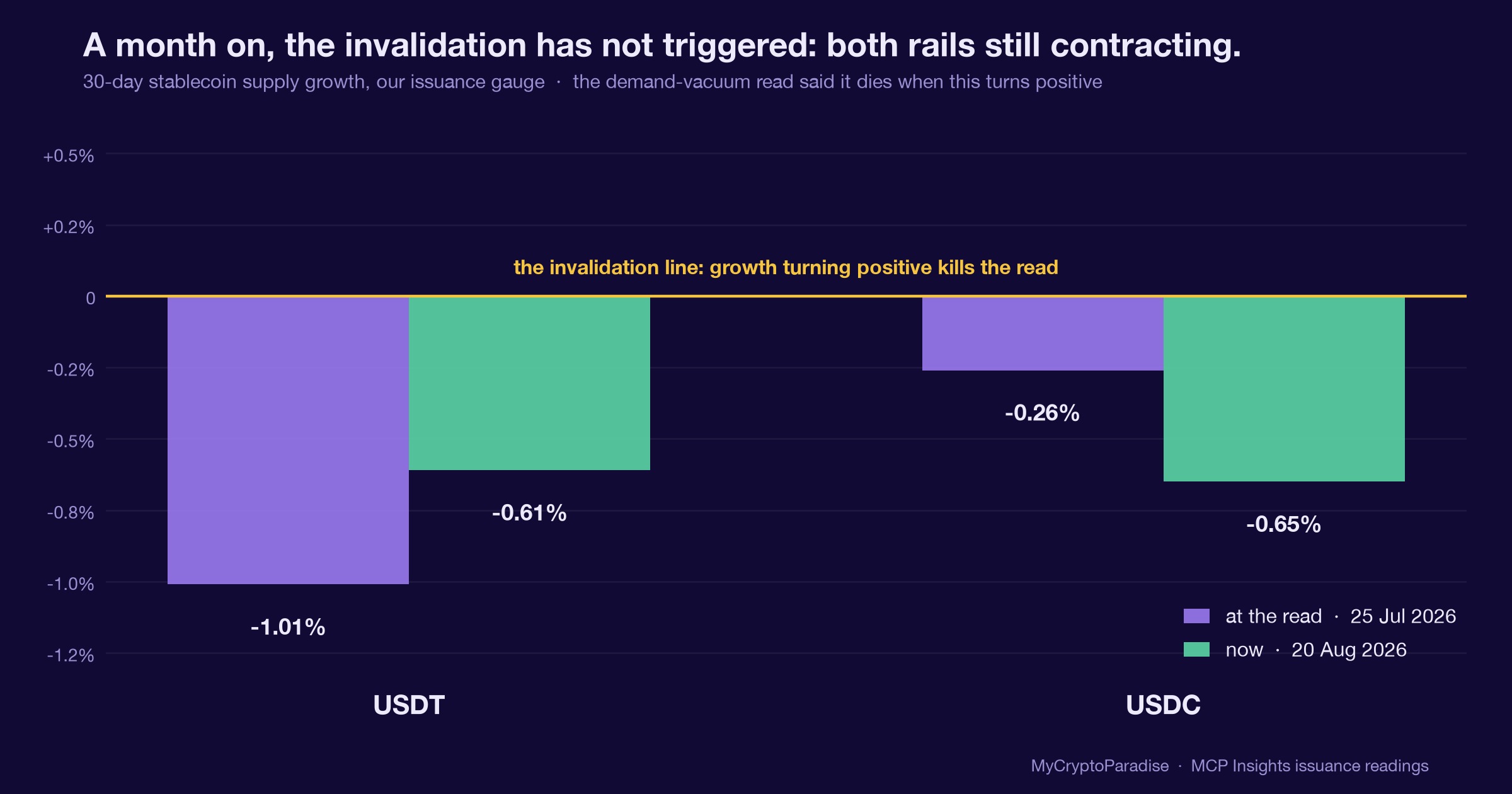
What happened to this particular read
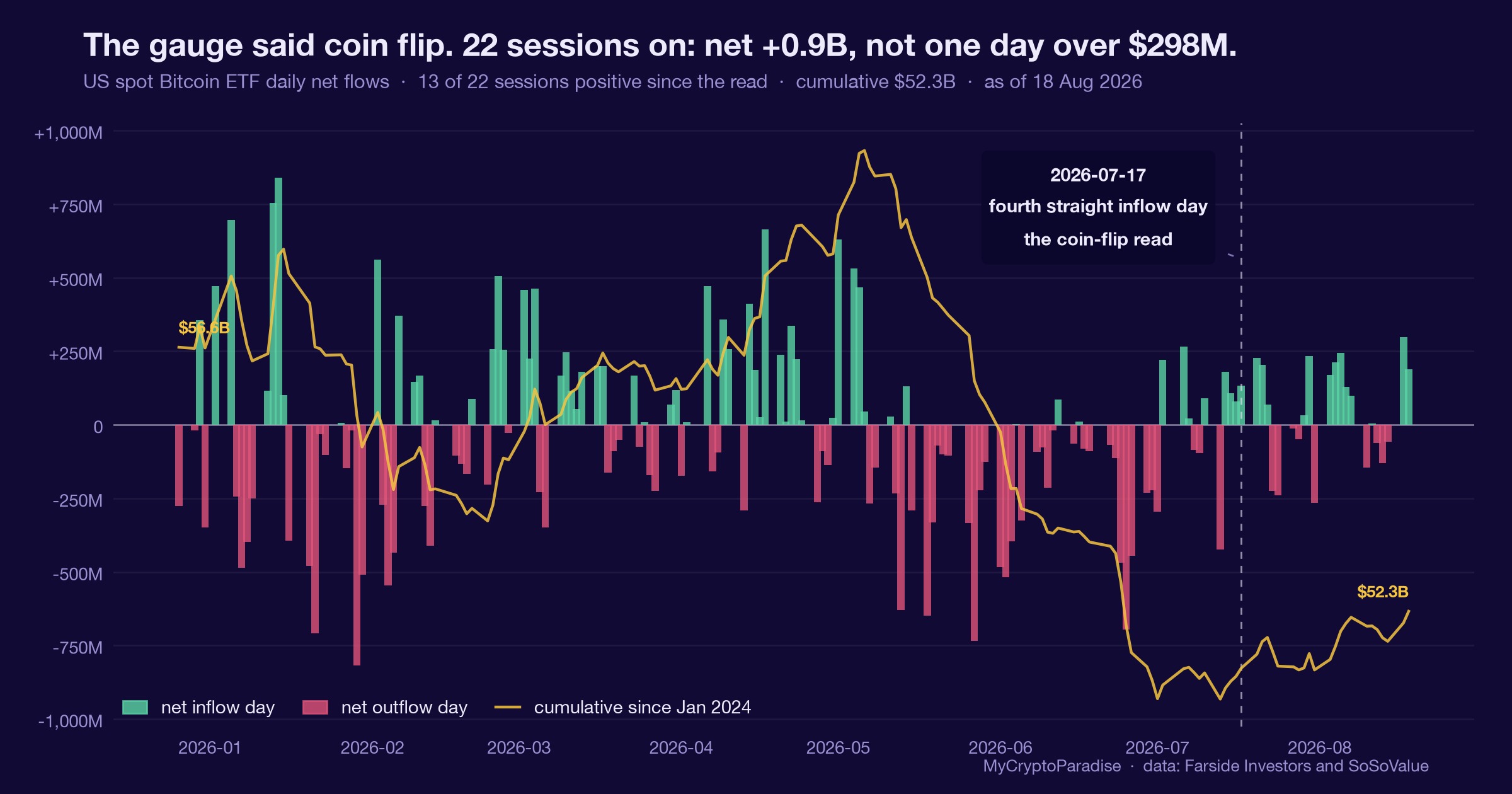
This piece is dated. It documents a specific reading from 18 July 2026, and we have deliberately left the numbers as they were.
That is the point of publishing a scorecard rather than a forecast. The value of a base rate is only visible if you can check what it did afterwards.
The framework outlives the reading. The next time spot breaks below the short-term-holder cost basis, the same five steps apply, with fresh numbers.
Frequently asked questions
What is short-term-holder cost basis in simple terms?
It is the average price paid by wallets that bought Bitcoin within roughly the last 155 days. When spot trades below that average, the recent-buyer cohort as a group is holding a loss. It is a behavioural level that emerges from real transactions, rather than a line drawn on a chart.
Does price always bounce off the short-term-holder cost basis?
No. Data from Bitcoin Research Kit puts the reclaim rate at roughly 28 of 66 tests since 2012, about 42 percent. That is below a coin flip. The level is useful for framing risk, not for predicting a bounce.
Is a record realised loss a sign the bottom is in?
Not by itself. Absolute loss figures scale with how many people bought recently, so a larger cohort produces a bigger number at the same percentage drawdown. Check the loss share and the historical reclaim rate before treating a record as exhaustion.
What invalidates a defensive read below cost basis?
A daily close back above the cost basis level, which was $67,948 on 18 July 2026. That shifts the recent-buyer cohort out of forced selling. Write your invalidation down before you act, so the decision is made while you are calm.
Where can I track this metric live?
Our Bitcoin cost-basis tracker shows the current cost basis and the share of short-term-holder supply in loss, updated as it moves. It sits alongside the funding, liquidation and positioning reads in MCP Insights.
Crypto trading involves substantial risk and is not suitable for everyone. Nothing here is financial advice; it is education only. Never risk more than you can afford to lose.
The private Extras feed, where the short-term-holder cost-basis and loss-share reads update the moment they shift, is part of PRO Paradiser, the intelligence layer behind the ParadiseFamilyVIP strategies.













Join the discussion
No comments yet. Pro Paradiser members, share how you are reading this.