In short
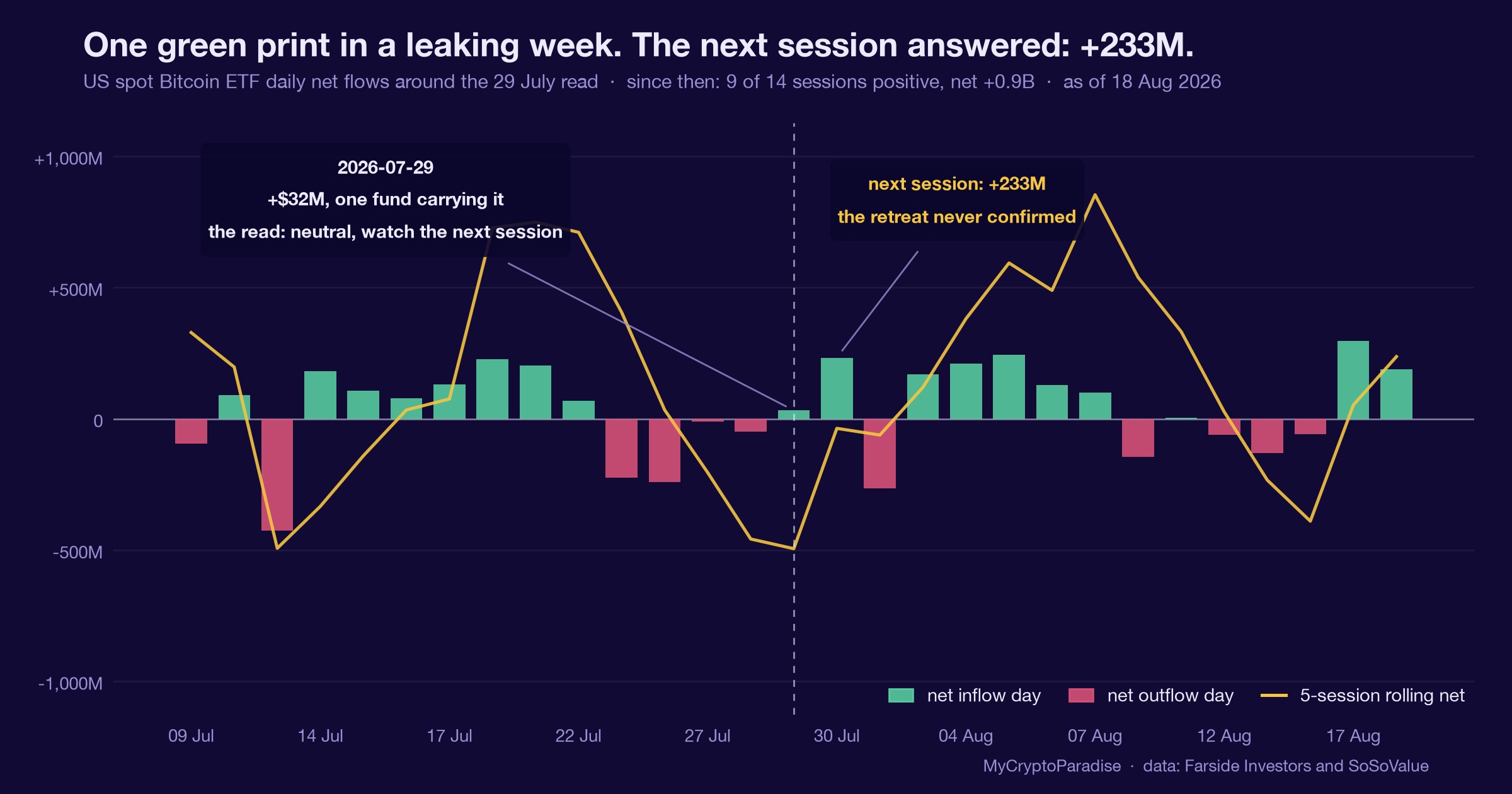
A net flow number can hide who is actually buying. On 29 July 2026 US spot Bitcoin ETFs booked a net +$32.11M, but per SoSoValue’s fund-level data BlackRock’s IBIT alone drew $89.83M while the rest of the complex was a net seller. One desk carried the day inside a week that had leaked $494.6M over five sessions. Our read was neutral with a deliberately short fuse: a second straight session where the net flips negative would confirm allocator retreat. The next session answered with +$233.1M, the retreat never confirmed, and in the 14 sessions since, 9 have been positive for a net of roughly +$0.9B. This piece is about reading breadth underneath a headline number, and about writing invalidations you can check by tomorrow rather than by quarter-end.
Why breadth matters more than the net
The daily ETF net is a sum, and sums flatten. Eleven funds selling while one buys can print the same headline as eleven funds quietly accumulating.
The difference is who the marginal allocator is. Broad inflows mean an institutional bid with many independent decisions behind it. A single-fund day means one desk’s flows, whatever their reason.
Neither is a signal by itself. But mistaking concentration for conviction is how one green print gets traded as a trend.
The 29 July reading
The net read +$32.11M. IBIT alone drew $89.83M, per SoSoValue’s fund-level data, which means the rest of the complex was net negative on the day.
Context made it thinner: the trailing five sessions had leaked $494.6M, and our ETF-tide grade sat at 50 of 100, dead balanced. The streak counter showed exactly one day of inflows.
On the Ethereum side, Morgan Stanley’s newly launched MSSE trust posted its largest inflow at $14.30M. New launches pull flow by construction; it said little about the standing complex.
Sentiment was soft too, with the Crypto Fear and Greed Index at 28. One fund, one green day, one fearful tape.
What is different here
The ParadiseTeam writes invalidations with short fuses. A read that can only be graded next quarter is a story; a read that the very next session can kill is a process. The 29 July read named its kill condition for the following day, and the following day answered it.
The overnight test, and how it graded
The published invalidation: a second straight session where IBIT’s buying fails to offset the rest, flipping the daily net negative and dragging the tide grade below 45. That would have confirmed allocator retreat.
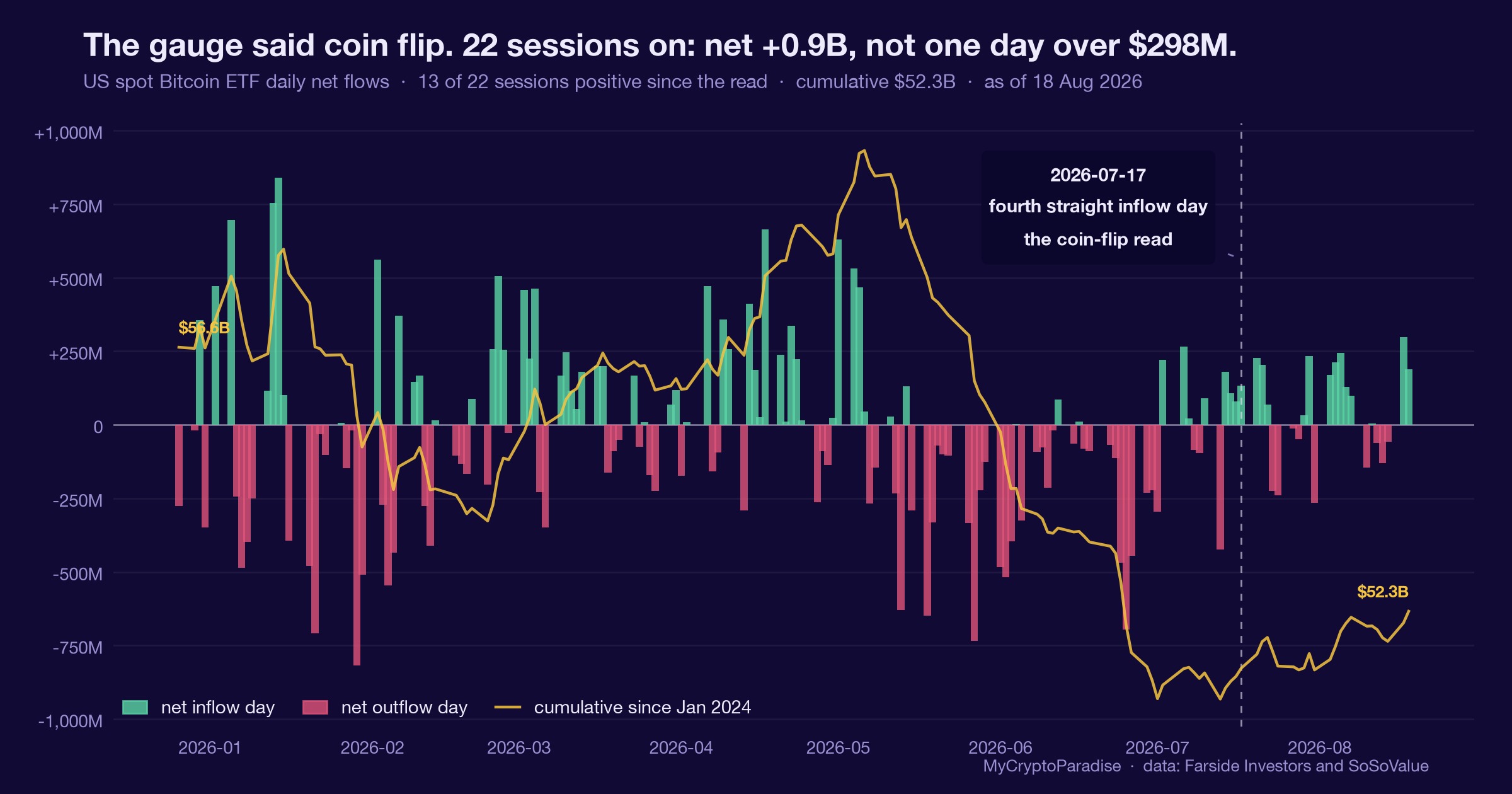
It never came. The next session printed +$233.1M, broad rather than carried, and the five-session rolling net turned from minus $494.6M to positive within the week.
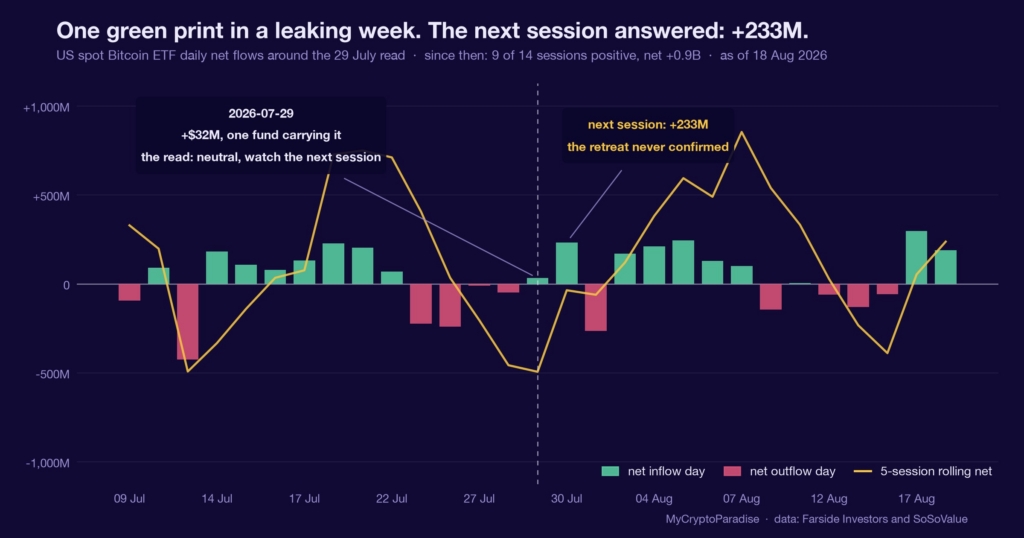
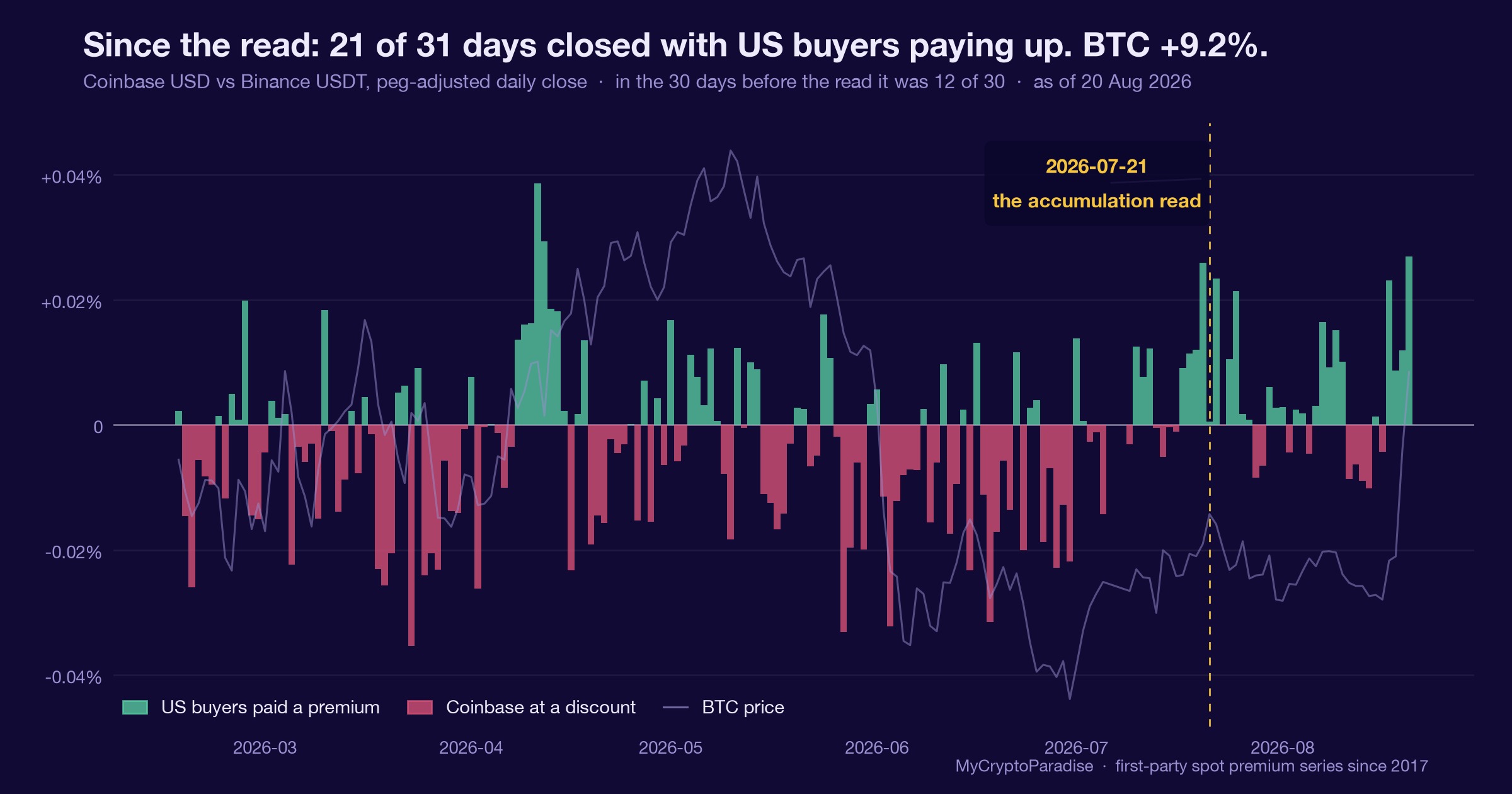
Since the read: 9 of 14 sessions positive, net roughly +$0.9B. The banner above shows the whole fortnight, with the read and its answer marked.
One honest note on instruments: our own archive fills fund-level detail on a lag, so the day’s per-fund split is SoSoValue’s data, named as such. The totals, the rolling net and the grading are ours.
Reading a flow headline yourself, step by step
- Split the net into its funds before reacting. One buyer and eleven sellers is not a bid.
- Put the day inside its week. A green print inside a five-session leak is a data point, not a turn.
- Discount new launches. A fresh fund pulling inflows is expected behaviour, not fresh demand.
- Set the fuse short. Write an invalidation the next session can trigger, and let it.
- Grade in public. A read that survived its overnight test earns the next one; a read that failed gets said so.
You can watch the live streak, breadth and cumulative curve on our Bitcoin ETF flow tracker, with leverage context on the MCP Insights hub and live funding rates.
Act and invalidate
| Scenario | What confirms it | What kills it |
|---|---|---|
| Broad bid returns | Inflows spread beyond one fund, tide grade lifts above 50 | Breadth narrowing back to a single issuer |
| Allocator retreat | Consecutive net-negative sessions, tide grade below 45 | A broad positive session inside the window |
| Balanced drift | Green and red days alternating, rolling net near zero | Either streak extending past three sessions |
Posture: a balanced tide with thin breadth rewards patience. For most traders, one carried print changes nothing, and the highest-probability trade remains no trade. New to fund-flow mechanics? Start with MCP University.
Frequently asked questions
What does breadth mean in ETF flows?
Breadth is how many funds share the day’s direction. A net inflow carried by one issuer while the rest sell is narrow breadth; the same net spread across many funds is broad. Narrow days tell you about one desk, broad days about an institutional bid.
Why did one fund carrying the net matter on 29 July 2026?
Because IBIT’s $89.83M inflow exceeded the entire +$32.11M net, meaning the rest of the complex sold. Inside a week that had leaked $494.6M, that read as concentration rather than conviction, which is why we kept the read neutral instead of calling a turn.
What is a short-fuse invalidation?
A kill condition the very next session can trigger. Ours was a second straight failing session flipping the net negative. Short fuses make a read auditable immediately, and this one was answered the next day with a +$233.1M broad session.
Did the neutral read hold up?
Yes, in the way neutral reads should: it refused to trade one carried print, and the tape resolved on its own terms. Since the read, 9 of 14 sessions have been positive for roughly +$0.9B net, and the retreat scenario never confirmed.
Where can I track ETF flow breadth live?
Our Bitcoin ETF flow tracker shows the daily net, the streak, the cumulative curve and the tide grade. Fund-level splits are sourced from Farside Investors and SoSoValue, and the positioning gauges sit alongside in MCP Insights.
Crypto trading involves substantial risk and is not suitable for everyone. Nothing here is financial advice; it is education only. Never risk more than you can afford to lose.
The private Extras feed, where the flow breadth, tide grades and short-fuse invalidations update as each session lands, is part of PRO Paradiser, the intelligence layer behind the ParadiseFamilyVIP strategies.




















Join the discussion
No comments yet. Pro Paradiser members, share how you are reading this.