In short
Max pain is the strike where the most option premium expires worthless. Settlement often drifts toward it, which is why traders watch it into an expiry. On 26 July 2026 Bitcoin traded at $64,592, less than 1% from the $64,000 max-pain strike on a $9.6 billion monthly expiry, and we called it a pin rather than a launchpad. It settled at $63,910.83, inside the zone. We are still not going to tell you the pin rate, because our own archive holds five graded expiries against a pre-registered minimum of forty. Two of those five landed inside. That is a coin flip on a sample too small to be a coin flip. This piece shows you how to read an expiry pin, and why the honest answer to “how often does it work” is currently “we do not know yet”.
What max pain actually is
Every option strike has open interest sitting on it. Max pain is the price at which the largest total value of those contracts expires worthless.
It is arithmetic, not a forecast. You take the open interest at every strike, work out what the writers would pay at each possible settlement price, and find the price where they pay least.
The reason it matters is incentive. Option writers are usually the better-capitalised side, and they hedge continuously. That hedging can nudge spot toward the level where their book hurts least.
Can, not must. The pull is real but weak, and it competes with every other force in the market.
The 31 July expiry, as we called it
The monthly expiry carried about $9.6 billion in BTC notional across the chain, per first-hand Deribit option-chain data. Max pain sat at $64,000 with spot at $64,592, roughly $592 above the strike.
Distance to that strike was 0.2 sigma. Price was already sitting on the magnet, which is the least interesting place for it to be.
Call open interest towered higher up: about 25,438 BTC on the $70,000 strike and 26,217 BTC on $72,000. Those walls sat 8% to 11% above spot.
Unreached strikes do not pull settlement. A wall only matters if price travels to it.
Downside was thinner: put open interest clustered near $60,000 and $50,000. The chain ran a 0.28 put/call ratio, heavily call-skewed, which is positioning rather than permission.
You can watch the live version on our Bitcoin max pain tracker.
What is different here
Most desks quote a max-pain hit rate they cannot show you the workings for. We freeze a receipt before every expiry, grade it afterwards against the zone we published, and refuse to quote a rate until the sample is large enough to mean something.
What actually happened
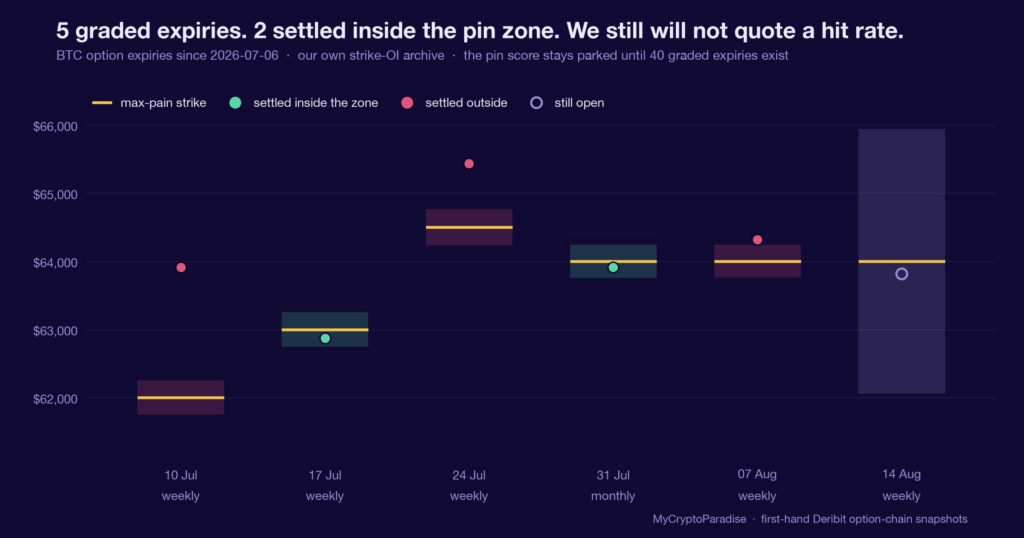
The 31 July monthly settled at $63,910.83 against a $64,000 max-pain strike. That is $89 away, and inside the pin zone we published beforehand.
The pin held. Now here is the part that matters more than the win.
Since our strike-OI archive opened on 6 July 2026 we have graded five expiries. Two settled inside the zone. Three settled outside, one of them 7.7 sigma outside on 10 July.
Five is not a sample. It is an anecdote with a spreadsheet.
Why we will not quote a hit rate
The gate is pre-registered at forty graded expiries. Until the archive reaches it, the pin score stays parked and reads “insufficient history”.
Pre-registering the threshold matters. If you pick the sample size after seeing the results, you can always find a number that flatters you.
Two of five is 40%. It would be trivially easy to publish that, and it would be close to meaningless: at this sample size the confidence interval spans almost the whole range between never and always.
A number with no error bar is not evidence. It is decoration.
This is also why the honest read on any single expiry is a gravity read rather than an edge. You are describing a weak tendency, not a tradeable frequency.
How to read an expiry pin yourself
- Find the max-pain strike and the notional size of the expiry. A small expiry pulls nothing.
- Measure the distance from spot in sigma, not in dollars, so expiries are comparable.
- Check whether the big strikes sit above or below, and how far. Distant walls are scenery.
- Read the put/call ratio as positioning, never as direction.
- Decide before the event what settlement would count as inside your zone, and write it down.
Step five is what turns watching into measuring. Without a zone declared in advance, every outcome looks like a hit afterwards.
Act and invalidate
| Scenario | What confirms it | What kills it |
|---|---|---|
| Pin holds into expiry | Spot stays inside the published zone, drifting toward the strike | A sustained close outside the zone in either direction |
| Bulls reach for the call walls | Break and hold above the gamma centre | Rejection back under the strike on fading call demand |
| Bears press the puts | Loss of the zone floor with put open interest building | Reclaim of the strike into settlement |
Risk posture for most traders into an expiry pin: no trade. Gravity is not an edge, and settlement week is a poor time to discover that.
The defensive play is to let settlement clear before sizing anything directional. New to reading option flow? Start with MCP University, and the wider positioning picture sits on our market insights pages.
Frequently asked questions
What is max pain in crypto options?
It is the settlement price at which the largest total value of open option contracts expires worthless. It is calculated from open interest at every strike, not predicted. Traders watch it because option writers hedge continuously, and that hedging can pull spot toward the level where their book loses least.
Does Bitcoin always settle at max pain?
No. The pull is a weak tendency that competes with every other force in the market. Our own archive has graded five expiries since 6 July 2026 and two settled inside the zone we published beforehand. That sample is far too small to support any claim about how often it works.
Why will you not publish a max-pain hit rate?
Because the gate was pre-registered at forty graded expiries and we have five. Two of five is 40%, but at that sample size the confidence interval spans almost the entire range. Publishing the number without the error bar would be decoration, not evidence.
Did the 31 July 2026 expiry pin hold?
Yes. It settled at $63,910.83 against a $64,000 max-pain strike, $89 away and inside the published zone. One expiry landing inside does not establish a rate, which is why the score stays parked.
How should I trade an option expiry pin?
For most traders the answer is that you do not. An expiry pin is a gravity read rather than an edge, and settlement week is a poor moment to size a directional position. Letting settlement clear first is the defensive choice.
Crypto trading involves substantial risk and is not suitable for everyone. Nothing here is financial advice; it is education only. Never risk more than you can afford to lose.
The private Extras feed, where the strike-by-strike expiry map and the live pin receipts update intraday, is part of PRO Paradiser, the intelligence layer behind the ParadiseFamilyVIP strategies.












Join the discussion
No comments yet. Pro Paradiser members, share how you are reading this.